Back in my day (ha!), if you wanted to go to college, you went to your high school guidance counselor’s office and picked up brochure after brochure of regional programs. If you were applying to a place like Harvard, you already knew what you were doing. For the rest of us, we skimmed glossy pages seeking a potential home. Who would have us? Who could we be? I remember choosing the following for a variety of not-great reasons: Loyola University in New Orleans (because New Orleans), St. John’s College in Santa Fe (sounded fancy), Colorado State in Fort Collins (briefly had visions of being outdoorsy), University of Puget Sound (water), and a now-forgotten culinary school brochure. If I’m being honest, the real reason I looked at any of them was to escape. I never really pictured myself as a college student and didn’t even know what I wanted in a career. I stared at the different campuses and all the smiling, beautiful people thinking: Is this me? I still don’t know why I brought the culinary school brochure home. I remember having no cooking experience, and no real desire to learn about food, but still being drawn to those tall, white hats and confident smiles over powerful crossed arms. The people in the culinary school brochure looked like they could move mountains. They fascinated and scared me. I threw the brochure away.
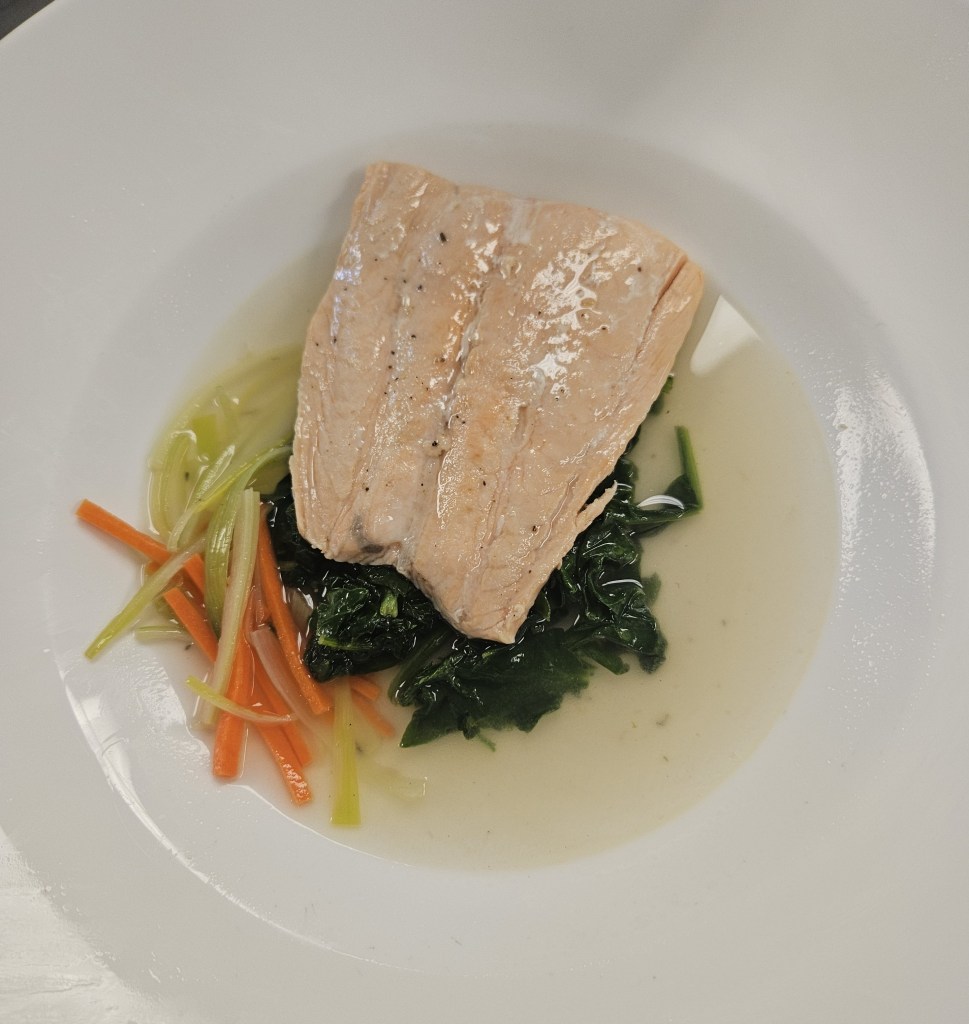
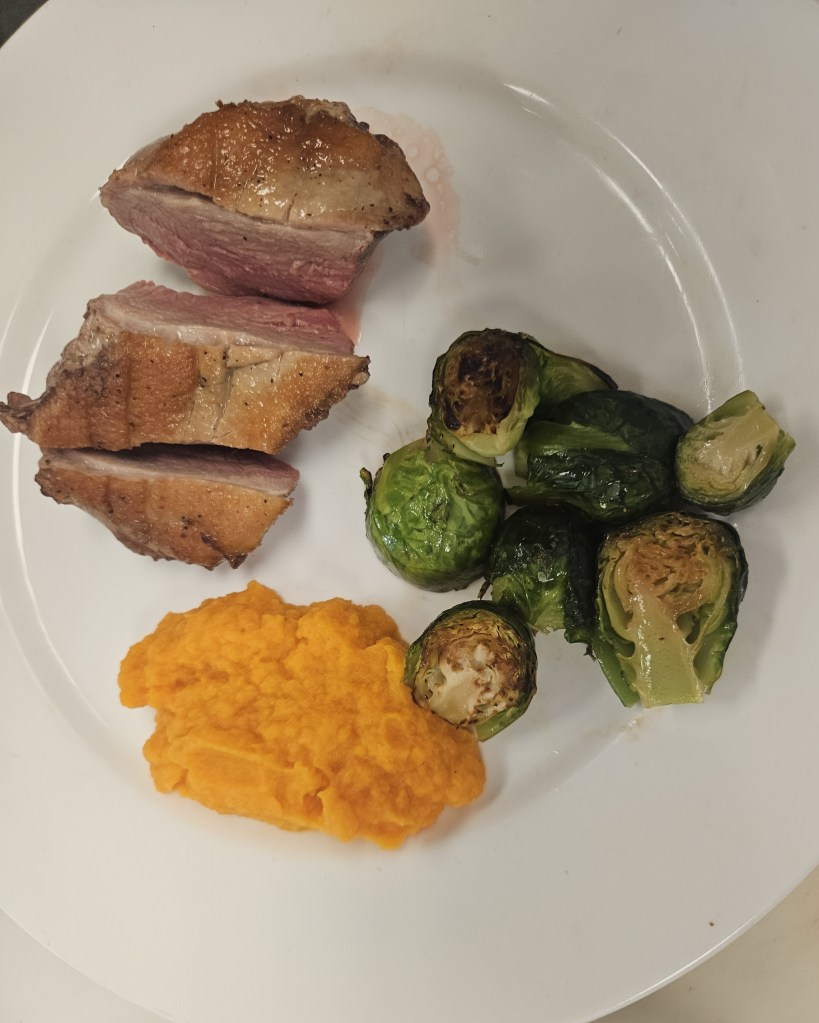
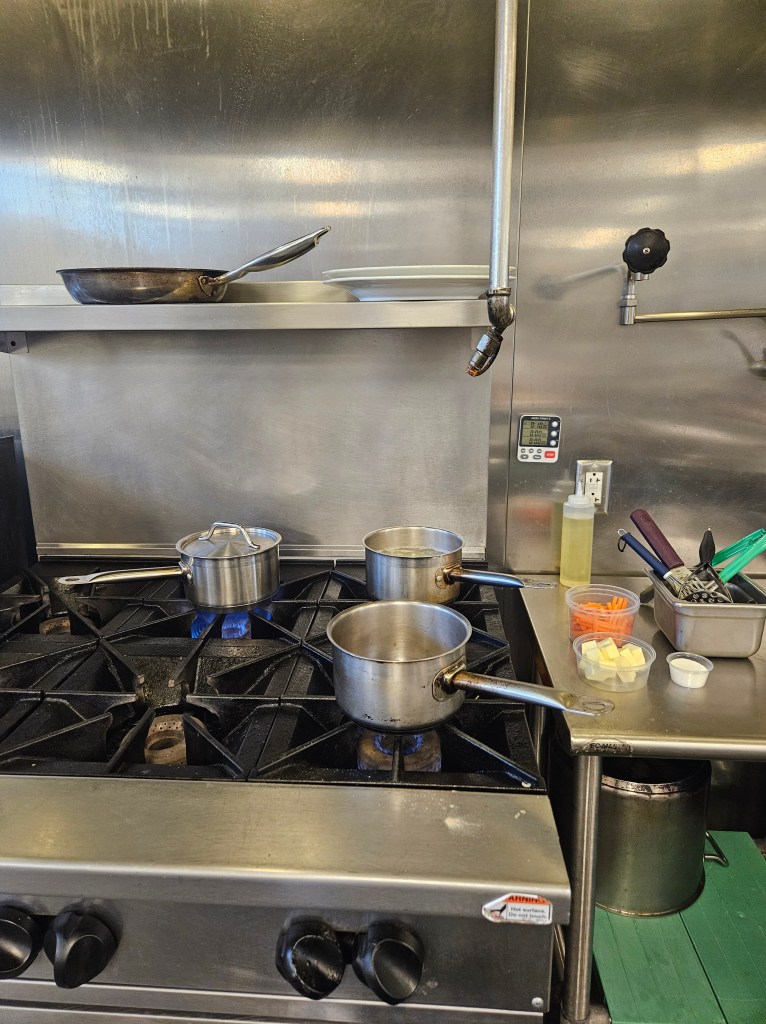
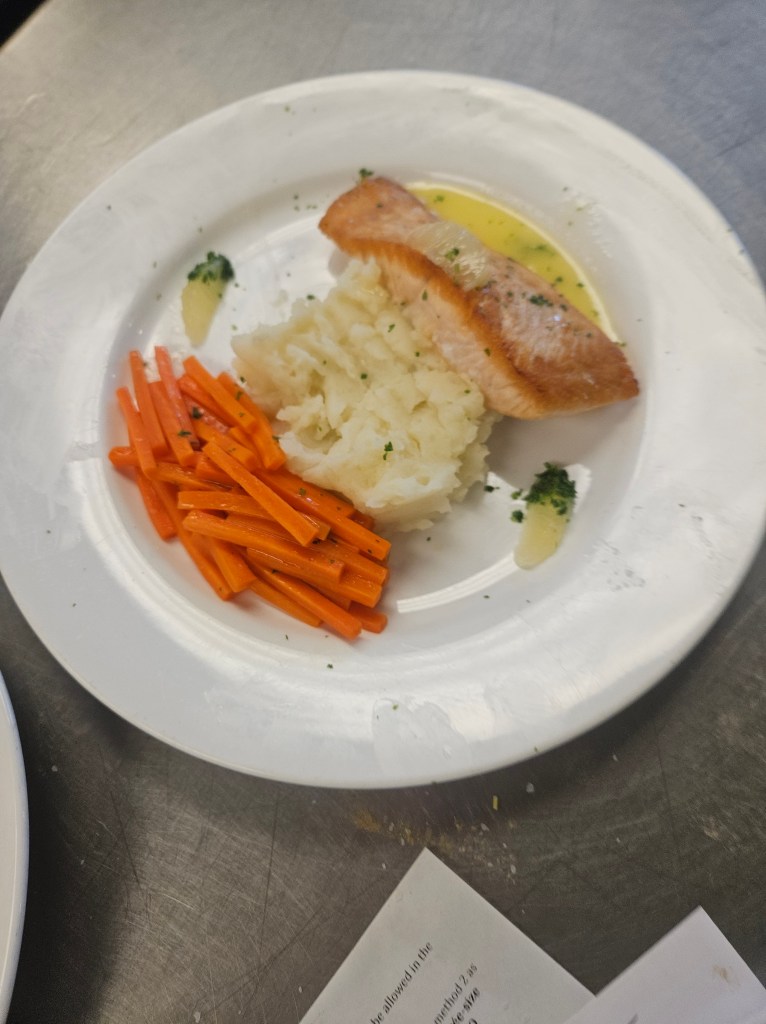
The final weeks of class had us preparing full entree plates served in aesthetically pleasing ways at correct temperatures. Planning is critical, especially for someone without industry experience like me. It’s incredibly difficult to keep certain foods hot while also cooking others. If you’ve ever made Thanksgiving dinner alone, you have an inkling as to what its like. Some items need to be served immediately. Others can hold, but only under certain conditions. We’re also sharing kitchen space. (I blessed my tiny home counters that helped teach me how to work clean in a contained space). Then, there’s the pressure of making the plate beautiful. I made numerous errors and learned a lot. It’s all so much harder than it looks!
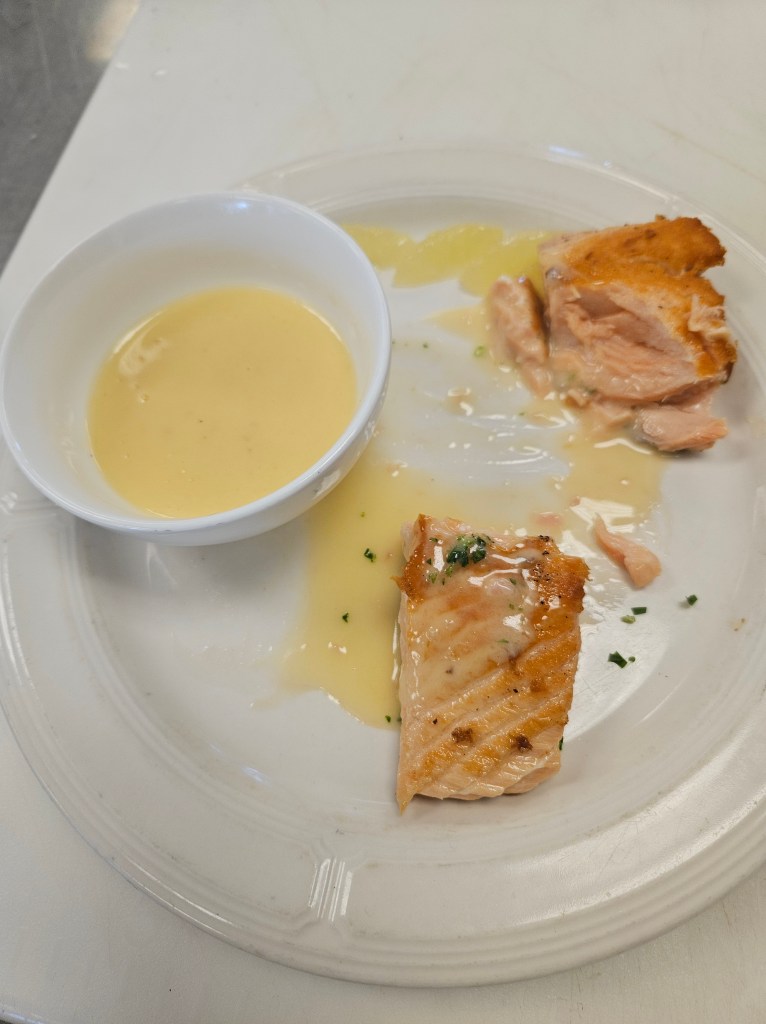
Poached salmon in nage sauce with sauteed spinach and julienned vegetables. I overcooked the salmon slightly, which you can see via the small amounts of white albumin on the meat. My plating overall was okay, but the vegetables could have been arranged more delicately.My station during prep. This is all for two entree dishes.Fried veal cutlet with braised cabbage, mashed potatoes, and a lemon sauce. My parsley went rogue.Roasted duck breast with butternut squash puree and caramelized brussel sprouts. My blood orange gastrique did not make it to the plate, due to time. I also cut the duck improperly. Cutting it length-wise is much prettier. Everything tasted great, though!Working “clean” gets drilled into us. It’s more than just not spilling things. It’s about keeping your space tight and tidy, with everything you need close at hand.Seared salmon with mashed potatoes, glazed carrots, and beurre blanc sauce.
That’s a wrap on my first semester! I’ll be taking a writing break until school starts back up. Intermediate Culinary Arts, I’m on my way!
“If you’re not failing, you’re not trying.” – Carla Hall
This week, we cleared another hurdle in class: plating full entrees. All plates include a protein, starch, vegetable, sauce, and garnish. Each one must arrive to Chef on a hot plate (but not too hot), with all ingredients at the appropriate temperature. It’s like Thanksgiving, but with less family drama.
Well, that’s not exactly true. While I’ve been continuously impressed with the overall maturity and focus of this class, things are getting tense in the classroom kitchen. It’s been 13 weeks of intense physical and mental labor, with demanding coursework and long hours. Everything has more of an edge. A few arguments have broken out, and we’ve lost even more students. Starting with 24, we are down to 16 students. Attendance fluctuates as the real world collides with school. While it has been hard to be one of the slower, faltering students, I am lucky to not be studying so intensely during the wild waves of my early 20s (I paid my dues). I feel for the students who are still living at home, navigating familial obligations along with work and school. My path isn’t easy, but neither is theirs. Indeed, one of the most rewarding parts of this experience for me is learning more about the other students. Hearing their stories, why they love to cook, and what brought them to this class is special to me. If our stories are who we are, then, for cooks, our food is the sustaining spirit giving life to those stories.
Speaking of food…
The full plates are difficult. Timing things to be fully cooked at the same time is difficult. Keeping them warm and presenting them at temperature is even more so. Add the requirement of aesthetically pleasing plating and things get extreme. Different techniques help stagger certain foods. Some foods can be held at temp or reheated. I don’t have industry experience, so a lot of this information is new to me. However, being a home cook still prepared me for the juggling required of multiple plans enacted at once.
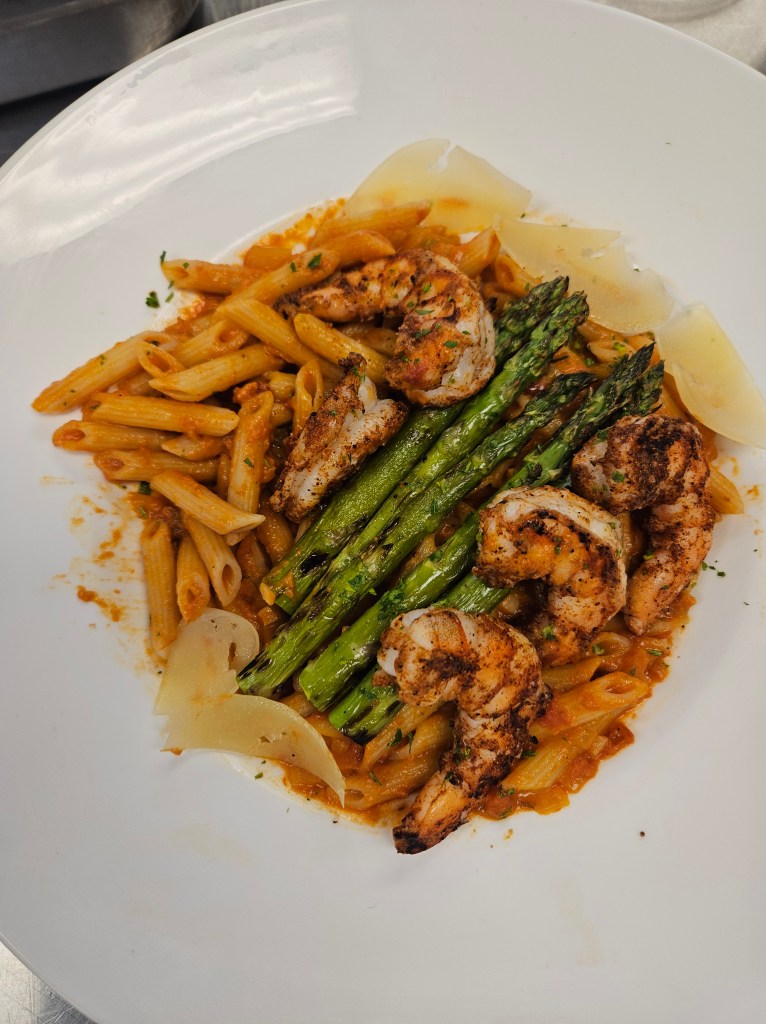
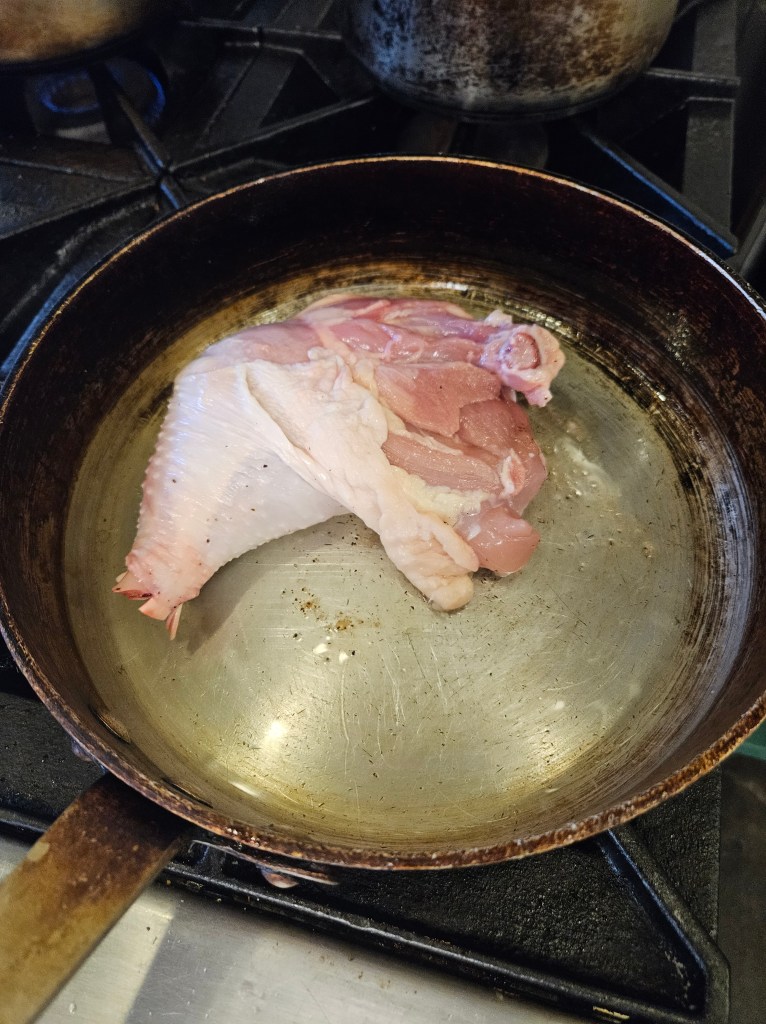
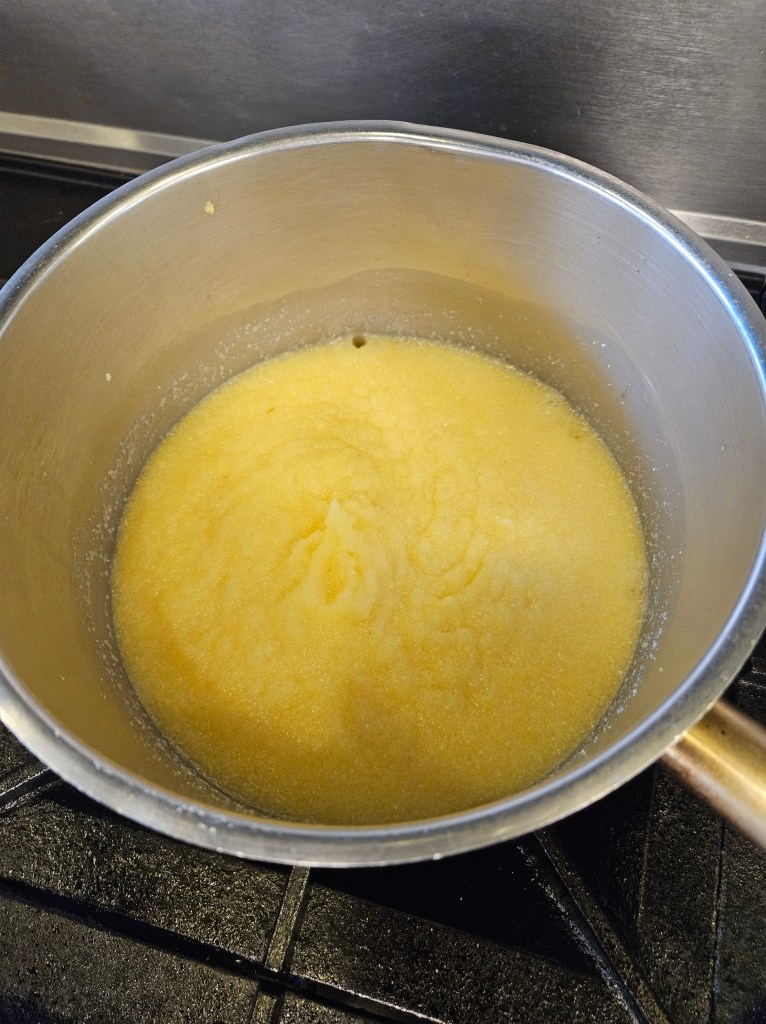
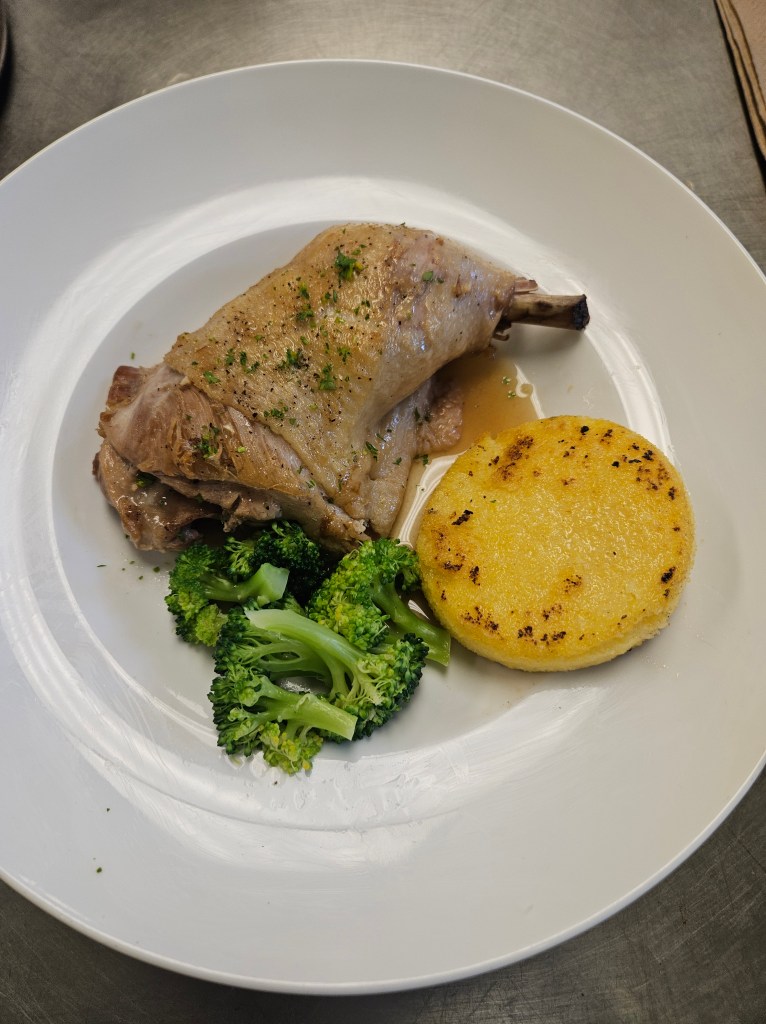
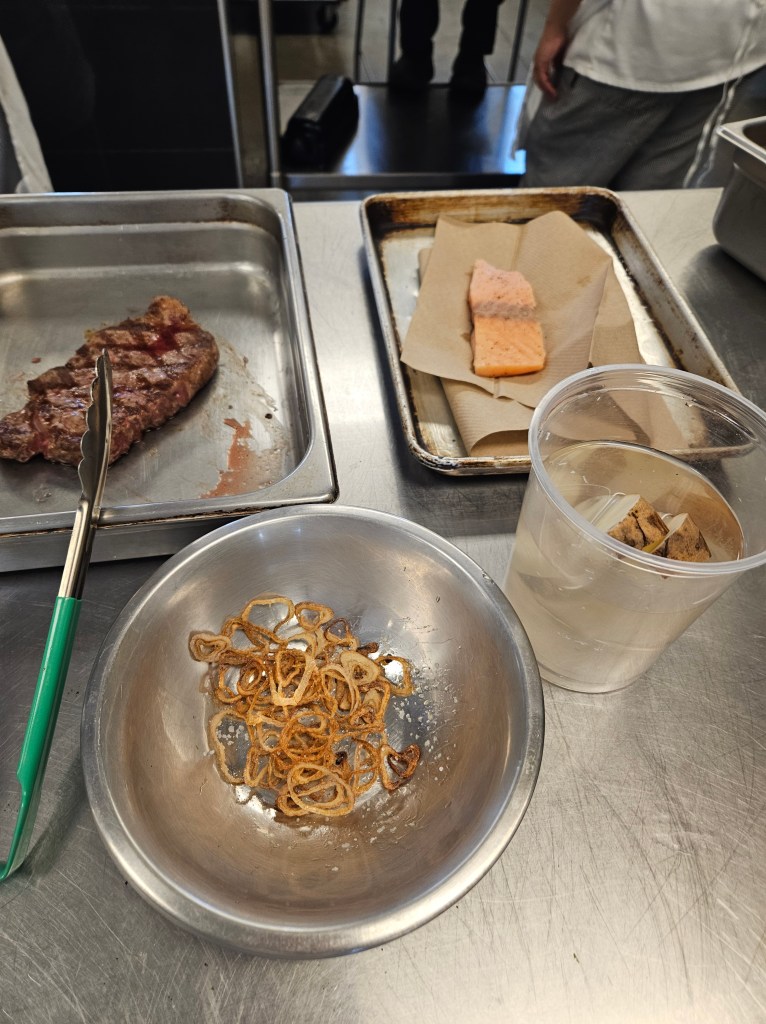
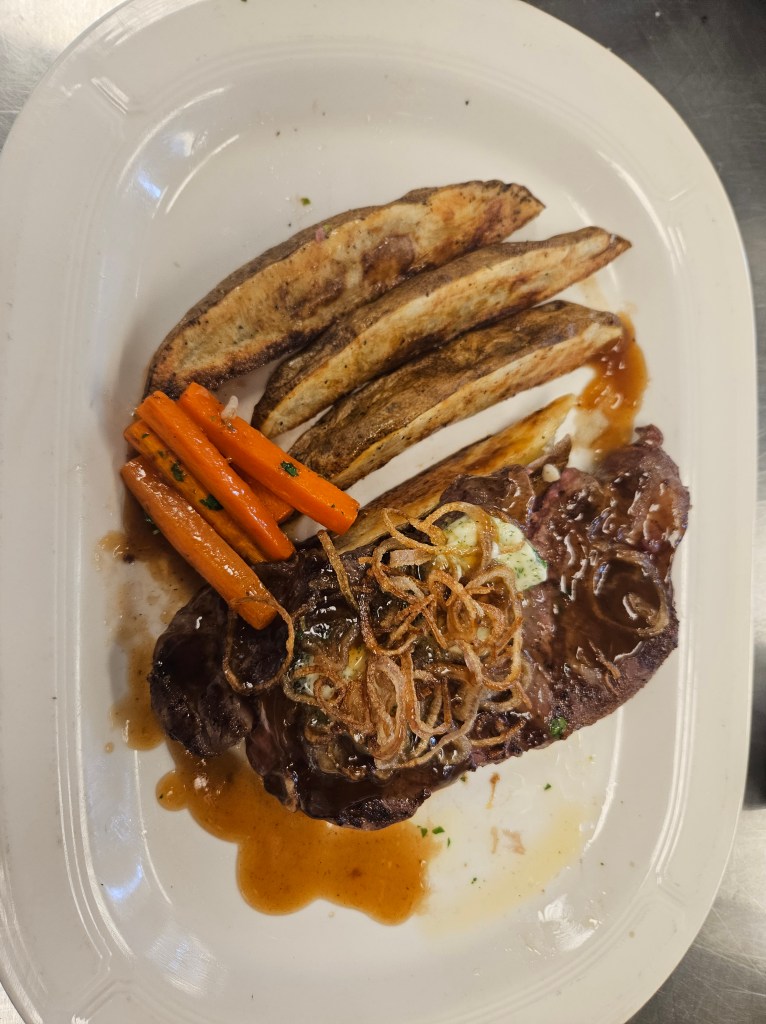
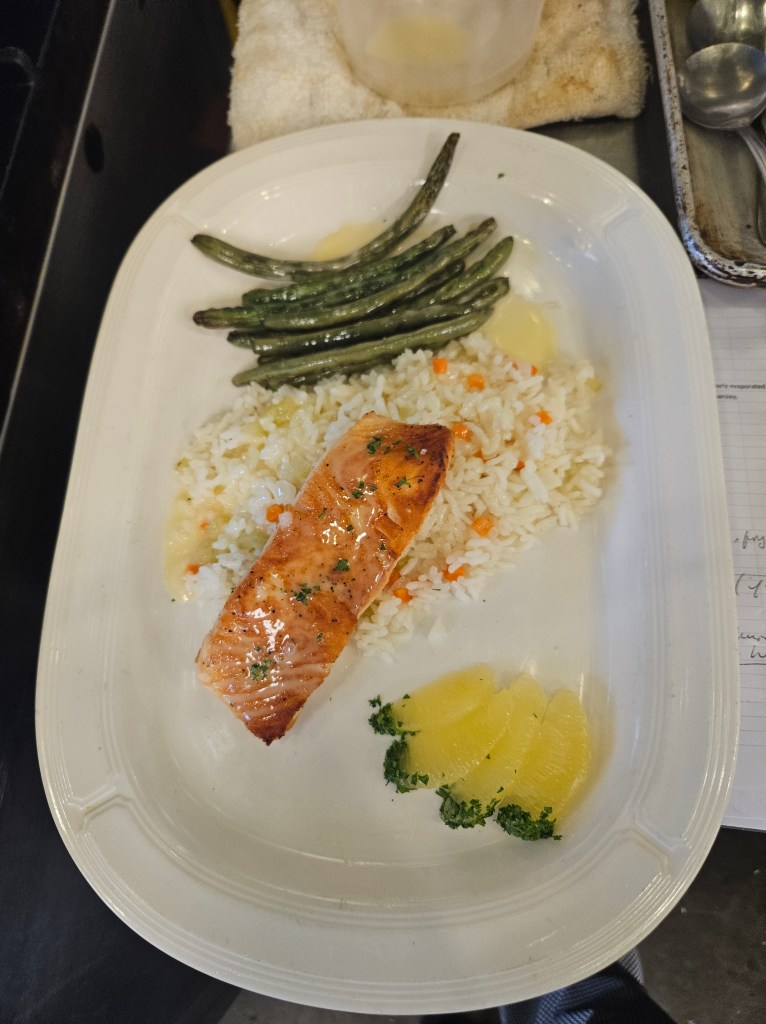
Grilled Cajun Shrimp Pasta with Grilled Asparagus, Creole Cream Sauce, and Parmesan Cheese garnishThe chicken quarters were massive. The older pans in the lab have bowed centers, so I had to keep moving them around to get a sear (I was not very successful, and still came out with some flabby skin).I was overjoyed to be working with polenta. I ran around the kitchen espousing the simple deliciousness of this side. I felt my Italian ancestors beaming as I cooked it down.Braised Chicken Leg with Polenta Cake, Steamed Broccoli, and Veloute SaucePrepping proteins and just-fried shallots. Trying to work clean.Ribeye Steak with Roasted Potato Wedges, Carrots Vichy, and Fried Shallots, drizzled with Demi Sauce and topped with Compound ButterSauteed Salmon with Rice Pilaf, Haricots Verts, Beurre Blanc Sauce, and Lemon Supremes garnish
Hi friends! It’s been an intense couple of weeks, so this going to be a photo dump post. We lost a day of class due to the July 4th holiday, and the following week, I wasn’t able to attend one class. I felt dysregulated but this week am back into my routine! A full post is coming later this week. Weeks 10 was Breakfast Week and Week 11 was Quick Food.
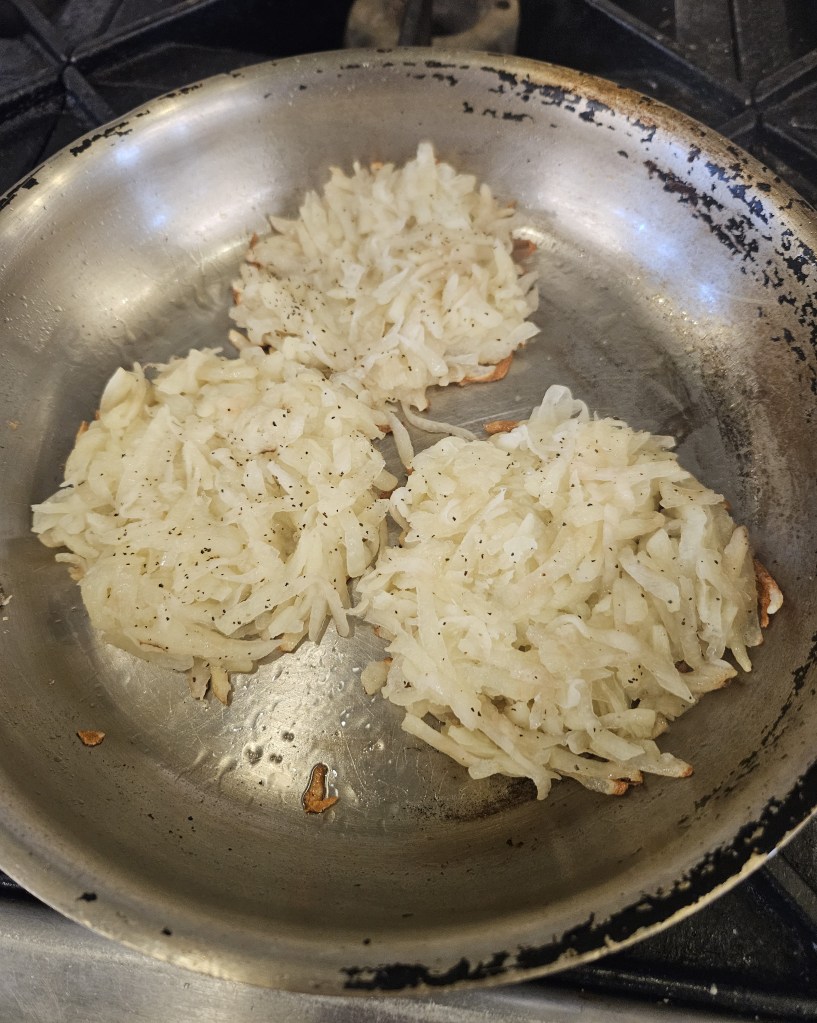
Oatmeal with brown sugar and cinnamon.Bacon and eggs!Feeling good about these hash browns.I should not have felt good about these hash browns. Burned on the outside and still raw inside. Once I burned them, I just stopped cooking because they were ruined and I didn’t have time to restart. Chef’s chicken wings with bbq sauce and salmon with Beurre Blanc sauce. We made all the sauces by hand!Chef approved of my salmon and beurre blanc sauce!Fall in love with these mozzarella sticks. Sous Chef made us marinara for dipping.Baking is next door and they sometimes bring us their treats!
“I tried to explain to Nami how much it meant to me to share food with her, to hear these stories. How I’d been trying to reconnect with memories of my mother through food…but I couldn’t find the right words and the sentences were too long and complicated for any translation app, so I quit halfway through and just reached for her hand and the two of us went on slurping the cold noodles from that tart, icy beef broth.”– Michelle Zauner
Michelle Zauner’s Crying in HMart is a love letter to grief, her mother, and ultimately food. The quote above describes eating naengmyeon with her aunt in Korea after the passing of her mother. I envy my fellow students who have stories of cooking at a young age with parents or grandparents. I envision the smells floating around them like a cloud as they work together to build a delicious meal. Laughter amid the sounds of thunking knives against wood and bubbling liquid. Maybe the occasional curse word as recipes come together or not. Lessons learned and handed down like heirloom jewelry and treasured maybe even more. A piece of jewelry is static. Food cooked together is living connection that transcends time and space. When you cook a recipe you inherited from a loved one, they are with you every time you make it.
My childhood relationships with food and cooking were not like that. My parents divorced when I was very young, so I grew up in two diametrically opposed and equally unhealthy kitchens. In my mother’s house, food was a reward for labor. If you were hungry, you ate what was placed in front of you, regardless of temperature, texture, flavor, or personal preference. It was also intimately linked with punishment. My sister and I were often sent to bed without supper or forced to finish our plates to prove a point. I remember complaining about the texture of some strange mix of canned vegetables (corn with…tiny bell peppers? Some odd early 90’s “medley”) and being locked in the pantry until I finished an entire bowl of it.
My father’s house balanced extreme over-indulgence with scarcity. A young single father who grew up as a spoiled only child, he had no real caretaking experience for young girls. We ate when he was hungry and at places he liked: fast food joints, late night diners, and all-you-can-eat buffets. After such strict restriction at my mother’s house, my sister and I went nuts during our time with him. We gorged ourselves on everything we couldn’t readily identify on menus or icy steel bins, from shrimp cocktails to patty melts to Caesar salads. We often made ourselves sick. He also would eat only 2 meals a day, skipping breakfast for massive piles of food at mealtimes. He did not cook and kept no food in the house, so whatever my sister and I could get when we ate out was it for the day. When I got older and started carrying around a backpack, we snuck rolls and candy bars to snack on when he wasn’t looking.
Because of these wild vacillations, I thought I was a picky eater (or just “wasn’t hungry”) until I met my partner. They introduced me to proper cooking techniques, seasoning (SALT!), and the flavors behind a variety of common meals. During our early years of dating, I found myself repeatedly thinking, “I didn’t think [insert food here] could taste like this!” My partner introduced me to all of my current favorite foods: olives, mushrooms, fish in a variety of forms, and HEAT! Chiles, wasabi, horseradish, anything bringing warmth to my palate and soul, is because of them. Truly, part of the reason I love food and cooking and was inspired to go to culinary school is due to their influence (Thank you, my love!)
Which brings me to soup. I was dreading this week, especially in the summer heat. Growing up, soup came from a can, fell into a bowl, and hit the microwave before being served at nuclear temperatures. Maybe if you were lucky, it came with a piece of white bread for dipping. I learned so much from Sauce Week that I was willing to suspend disbelief that soups could (and would) blow my mind.
First, more practice with knife cuts (of course, of course!) as we prepared a clear broth with vegetables. The purpose of this dish is to have a flavorful broth that doesn’t obscure the delicate cuts of the vegetables. Chef asked us for simple brunoise (1/8 inch cubes) but the recipes in my textbook highlighted even fancier cuts that made the vegetables look like gemstones in the dazzling liquid. Chef recommended fewer solids and more liquid, to really highlight the broth, but I loved the little bits so much, I just had to pile them into the cup. The result was a simple but elegant little bite, inviting and warm.
Clear broth with diced parsnips, carrots, celery, and peas.
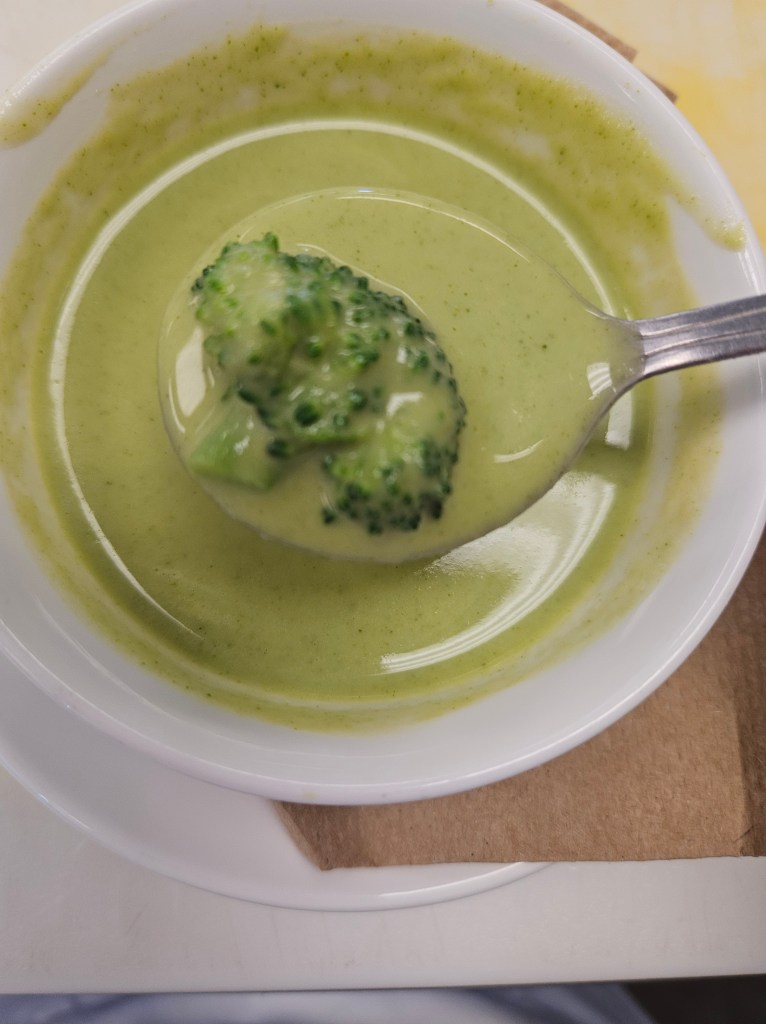
I had been dreading cream soups. On paper, nothing seemed more revolting. I had experimented with them in the past at home and felt truly baffled. It turns out, like most fine French cuisine, the answer is butter, cream, and attention. I had the chance to use a Vitamix to puree my broccoli and understood the hype of the pricey machines. My Cream of Broccoli came out smooth to the taste, with lovely little speckles. Garnished with a lightly blanched floret, and while I may not be ordering a cream soup for dinner any time soon, I was convinced of the appeal.
We also tackled a Pea Puree with Mint Cream. Yes, I whipped the cream by hand. Yes, my quenelle (the football shape of cold cream that should be smooth) is terrible. I brought myself to care about cream of broccoli, and even pea puree, but hand-whipped mint cream was out of my reach. My hands were shaking by the end of class when I prepped the cream.
Cream of Pea with Mint Cream and a bristly quenelle.
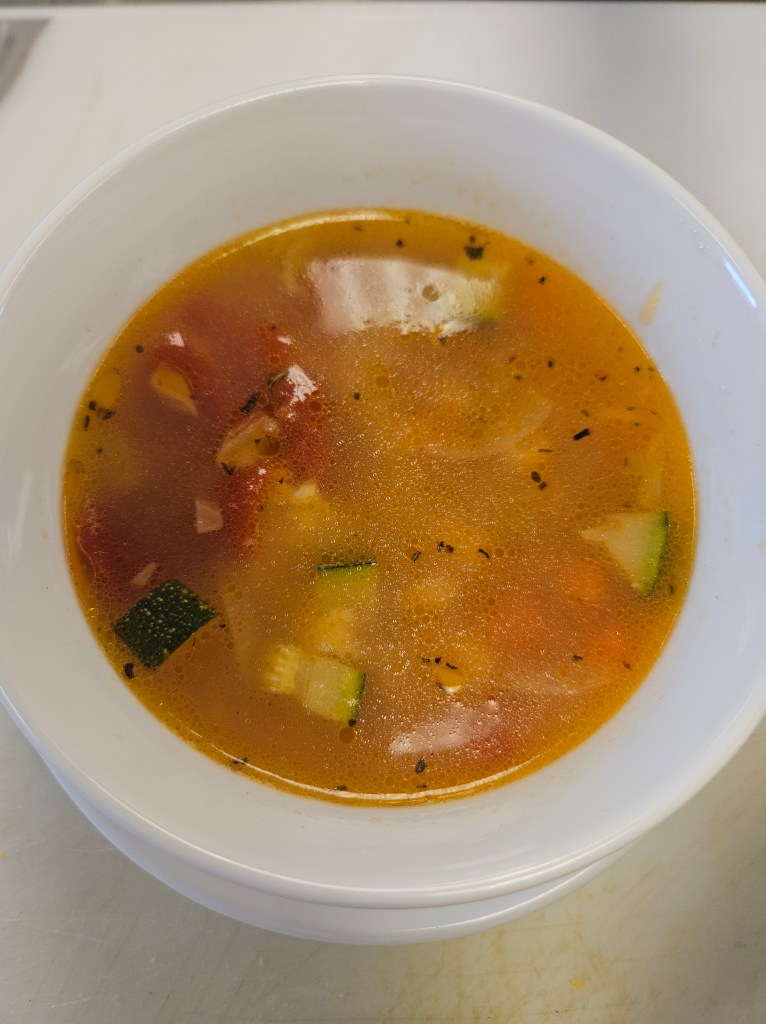
Traditional Minestrone felt much more like home. The recipe differed quite a bit from the one I made, but I was excited to see what would come of it. This version was delicate and light, but I craved the pile of garlic I usually added. The discreet little minces that our class recipe called for seemed to evaporate the moment it hit the liquid.
Fancy-pants Minestrone.
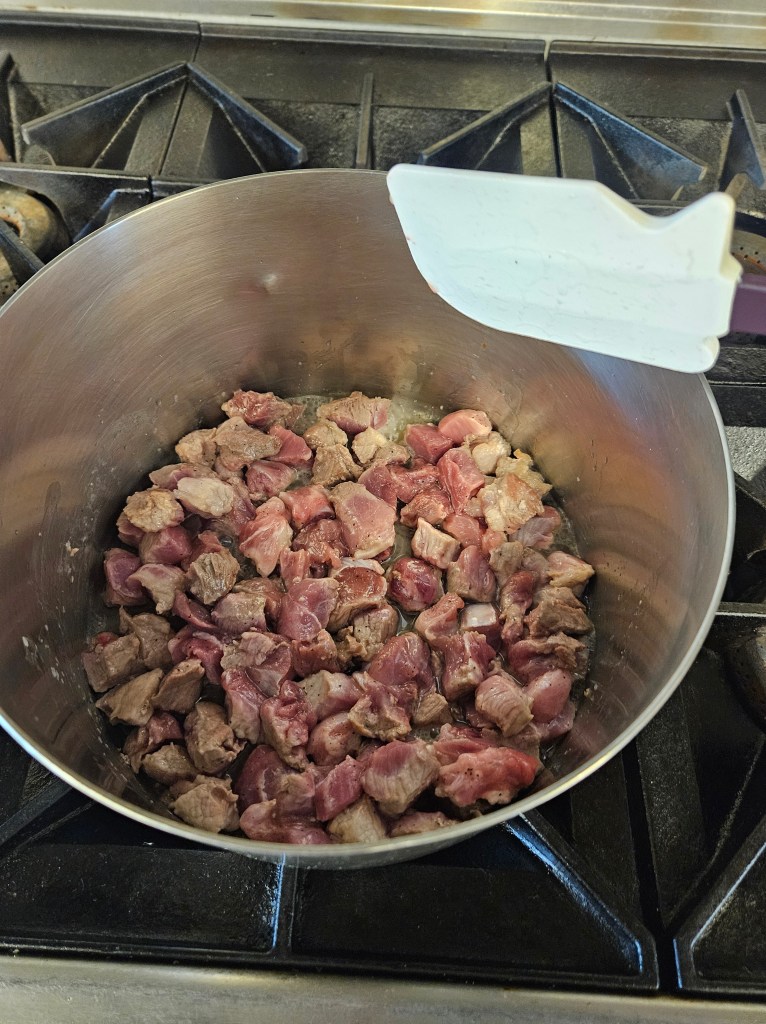
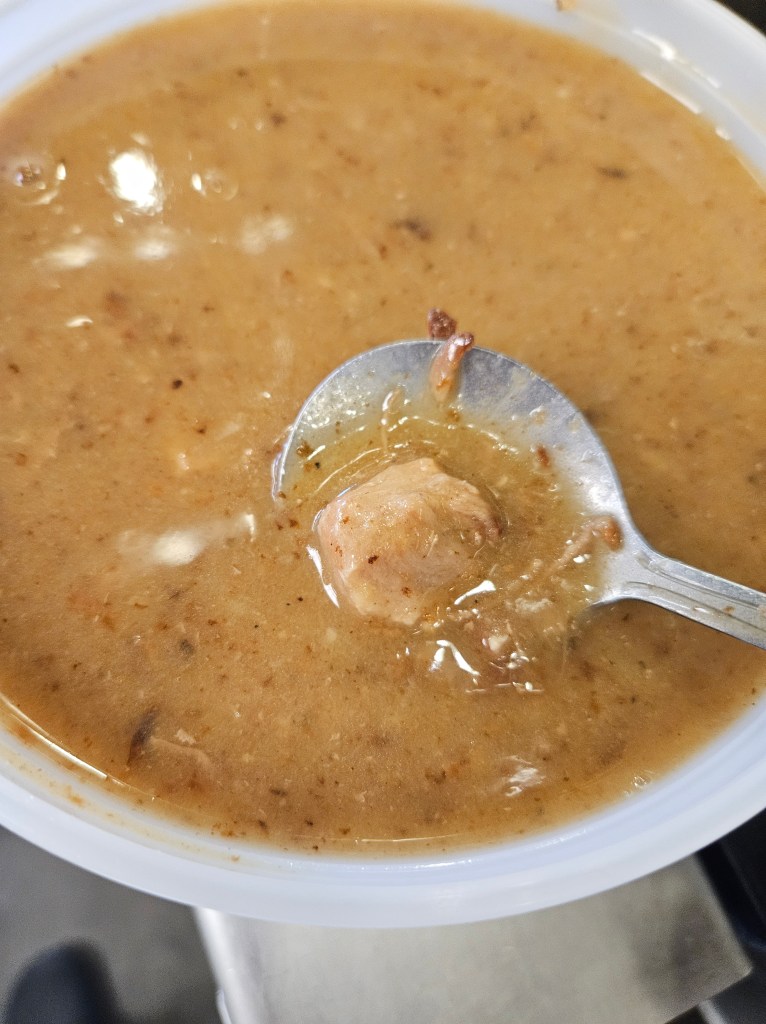
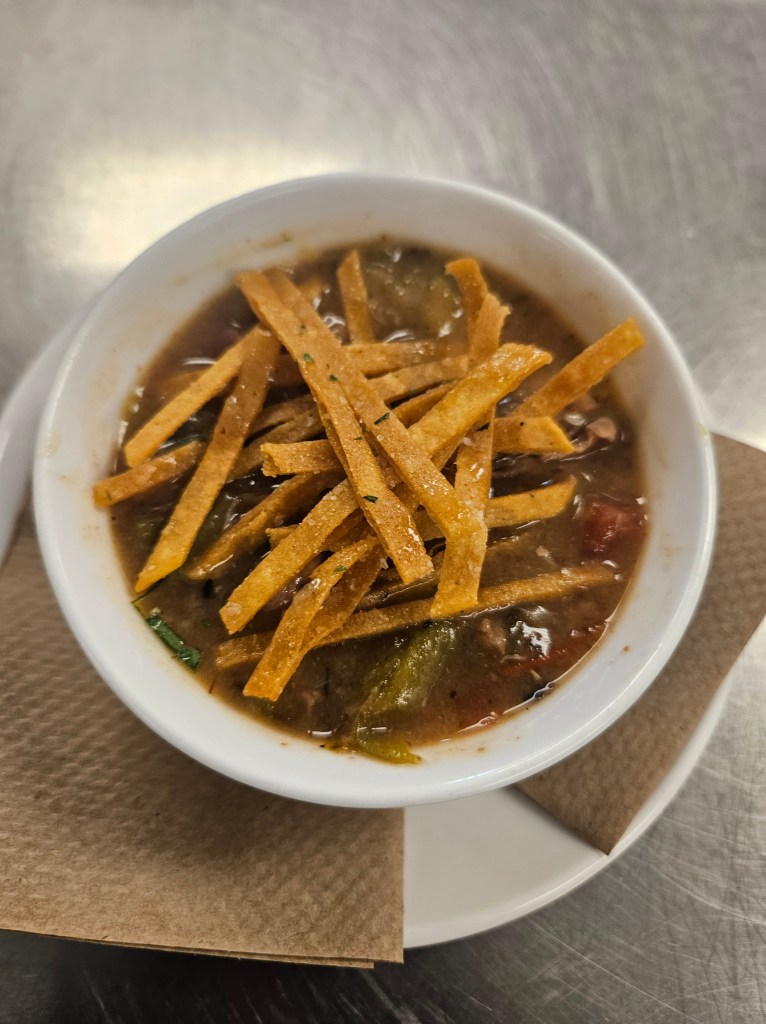
Which brings me to the real triumph: Green Chile Stew. This local hero of a dish is one of the greatest of the greatest. Pork, onions, tomatoes, potatoes, and heaps of hot green chile.
Sizzling pork, ready to be elevated.
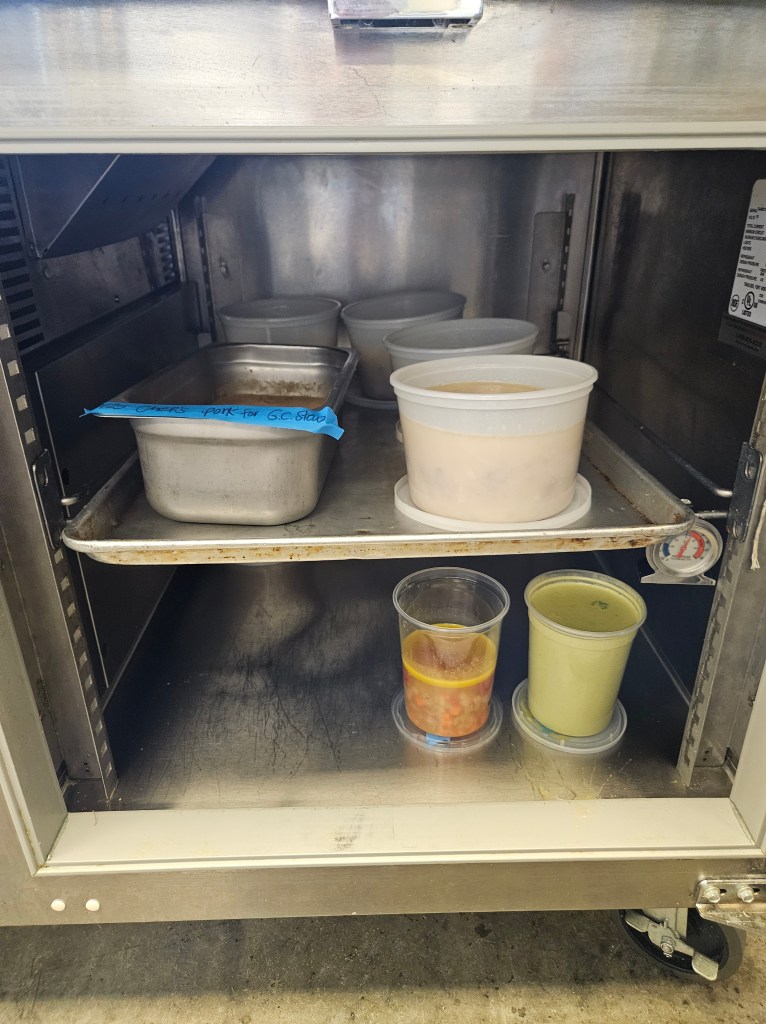
We cooked the stew for several hours, over the course of two days. Using the blast chiller, we cooled our work from Day One, so it would be ready for Day Two.
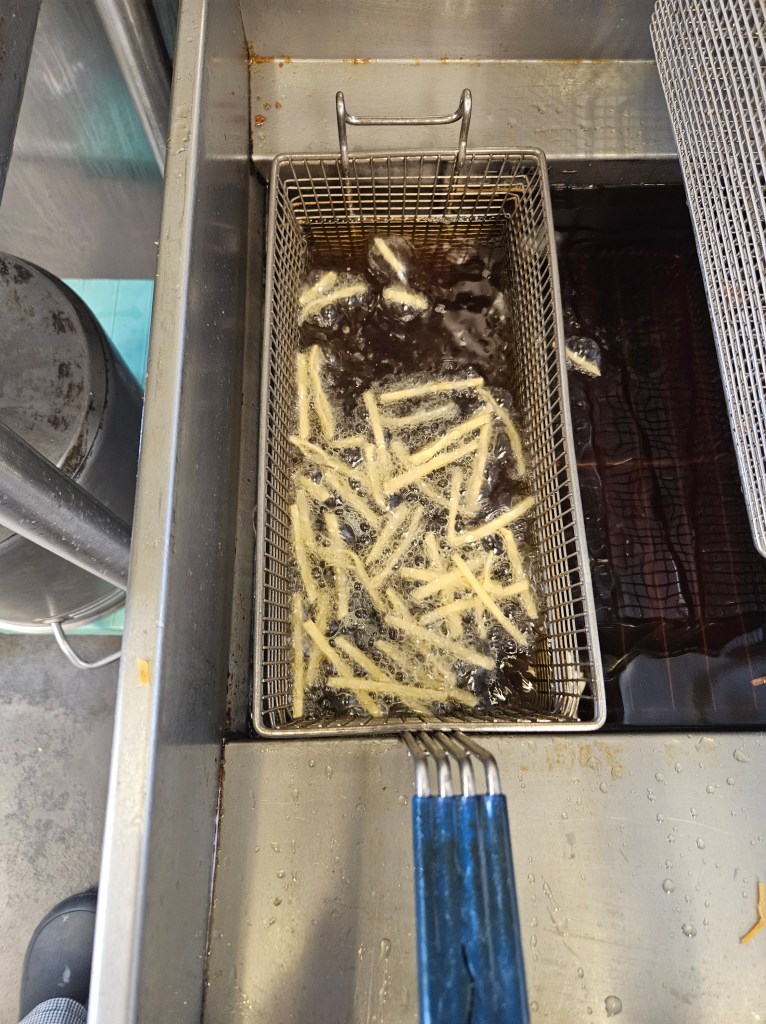
Soups cool exceptionally fast in the blast chiller, preventing bacteria from growing.Delicious Green Chile Stew in process, close to ready for presentation. A triumphant dish needs an epic topping, though.Corn tortilla strips becoming even more beautiful.Cue the singing of angelic choirs.
“God blessed me by making me transsexual for the same reason God made wheat but not bread and fruit but not wine, so that humanity might share in the act of creation.” – Mallory Ortberg
Happy Last Days of Pride Month!! Trans rights are human rights ❤ ❤ ❤
As temperatures climb into the 100’s this summer, I am thinking more and more about the physical toll of cooking. Indeed, the physical toll of creation, in general. There is nothing more painful than creation. Even the tiniest something-from-nothing (a sauce in an intro culinary school course, perhaps) requires invisible labor, time, struggle, and frustration. What you get is sometimes so little to show for it. While uploading these pictures from this week, I thought, “That’s IT?!?” But that is the magic of a perfect sauce. She’s unassuming, subdued, elegant, and you may even think she’s boring. When she’s allowed to shine and you take that first bite – BOOM! You see her for the star she is.
Building off the Mother Sauces, we made Small Sauces (once known as “Daughter Sauces”) from our previous work. First, though, because culinary school is as brutal as it can possibly be, we had a timed knife cut quiz.
Delicious carrots, uniformly cut, but a little short. My consistency is better, but I’m still not quite hitting the proper sizing.
Sauce-making is a lot of “hurry up and wait,” as Chef says. You prep your ingredients, get everything hot, and…watch…and wait…and wait…and watch. Things can change from hot to scorched in a heartbeat, so you can never let your pots go unattended. The result is rows of culinary students staring at burners for hours. It also feels pointless when you don’t fully understand the final results. I struggled this week as I stared at opaque white and opaque brown pots. What was the point? I didn’t understand. Until I tasted the final results.
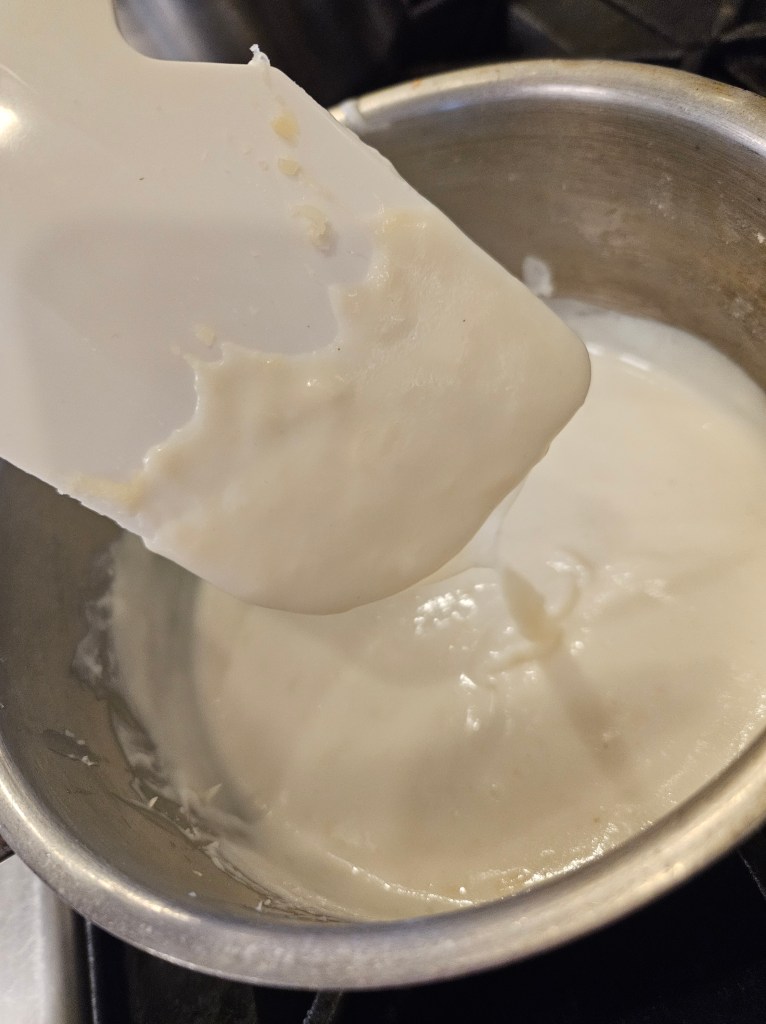
Mornay sauce is a cheesy enhancement of Bechamel. Sauce preparation is a lot of dipping a spatula and watching it drip, striving for that ideal nappe consistency.
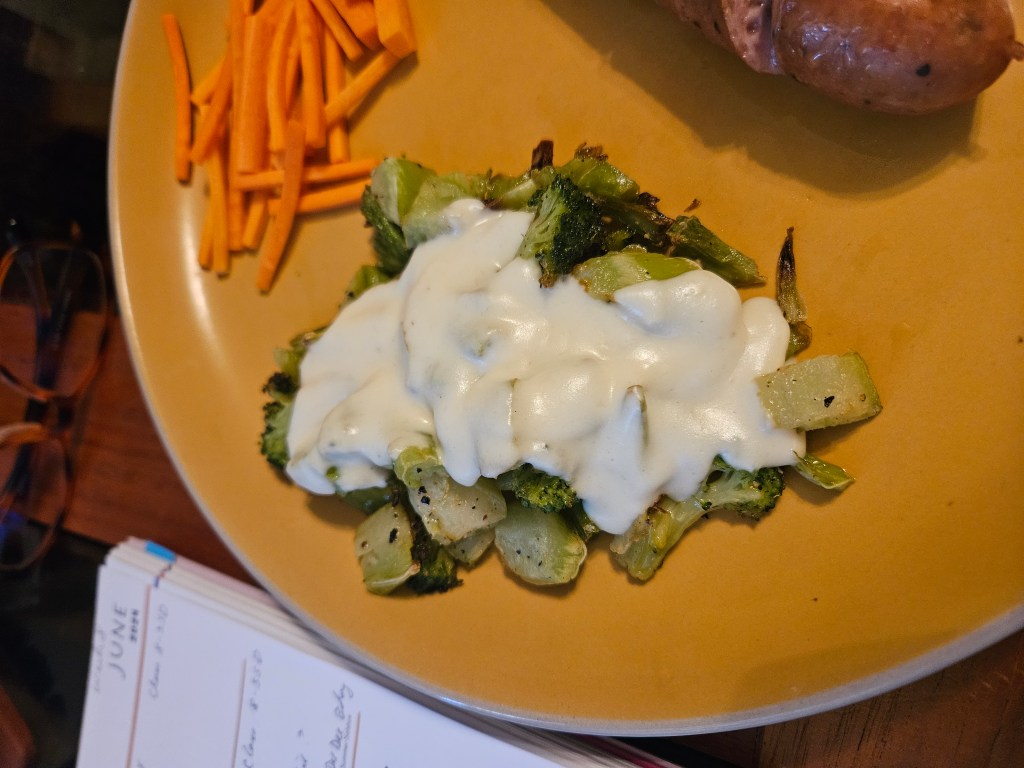
The result, when done properly, is incredible, though! The Mornay sauce is akin to the fanciest mac and cheese sauce you’ve ever had. I took mine home, refusing to lose a drop.
Mornay Sauce I brought home elevated little broccoli cuts to heavenly.
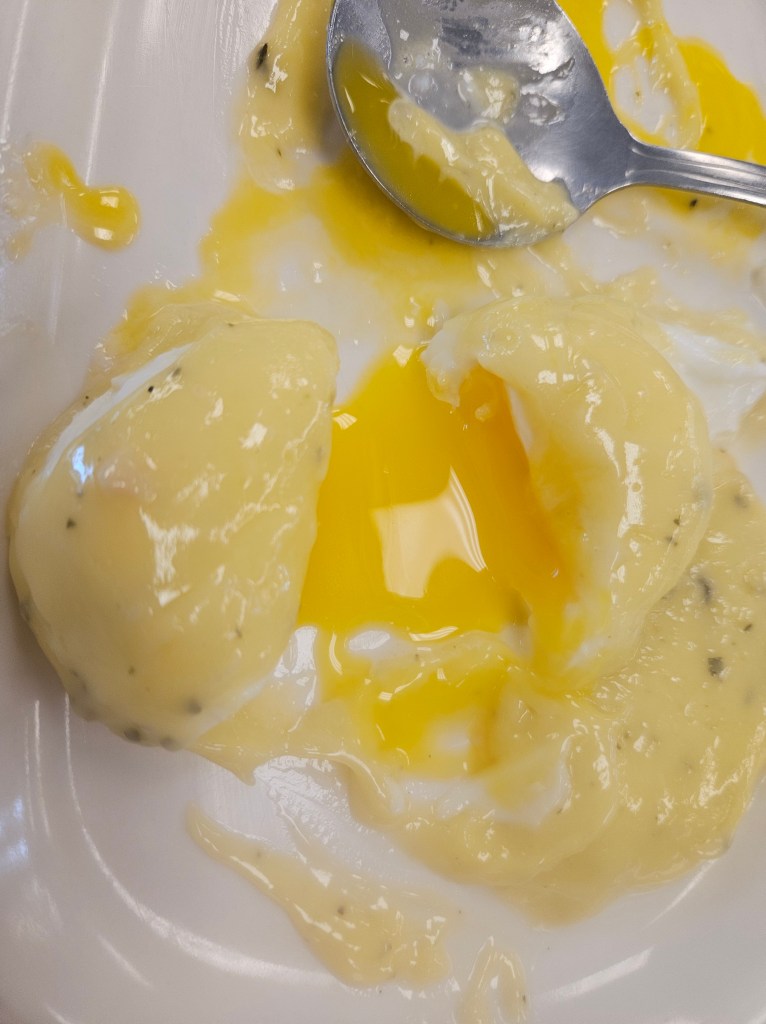
We also made Bearnaise, a version of the accursed Hollandaise. This plate was one of my first attempts at presenting a whole plate at the correct temperature. I par-poached the eggs, set them aside, prepared the Bearnaise and brought it to temperature, then finished cooking the eggs. I managed to plate them all hot at the same time – NOT an easy thing to do.
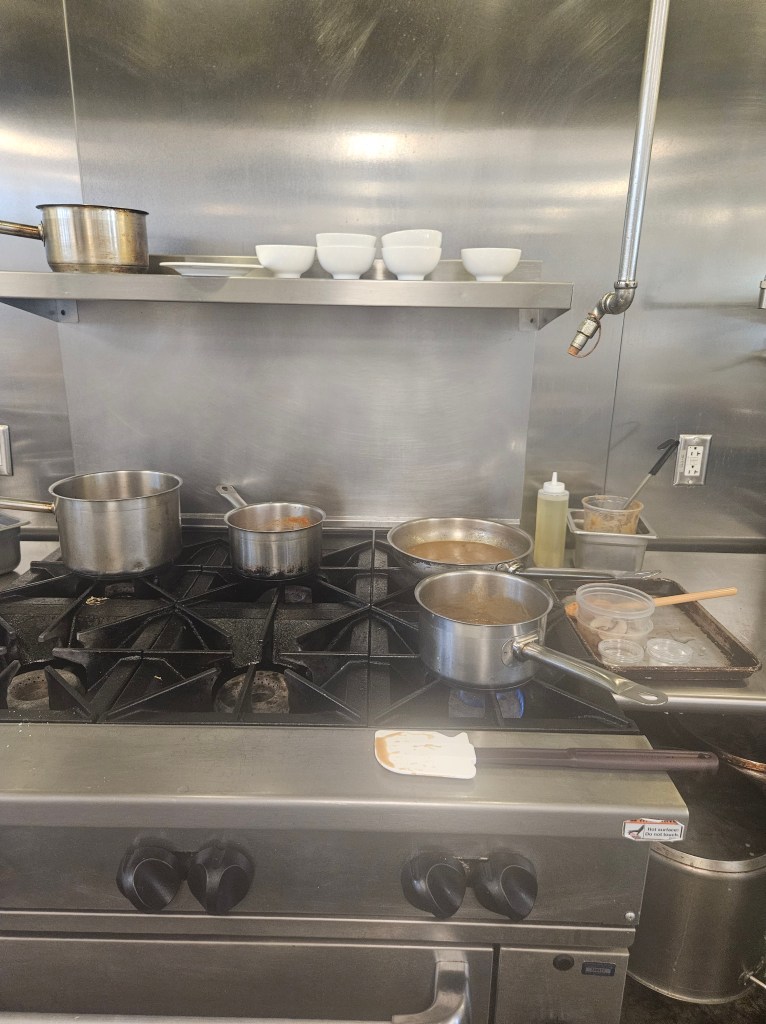
I DID IT!!!! Perfectly poached eggs with a Bearnaise sauce (an enhancement of a Hollandaise).The sauces don’t look like much just sitting on the burners. These are Lyonnaise (top) and Chasseur (bottom). Both have Velouté as a base. Lyonnaise is reduced with onions and Chasseur with onions and tomatoes. They packed an incredible flavor punch. I was stunned at how different the final taste was, despite both being from the same Mother Sauce.I adore mushrooms, so I could not let my Chasseur go to waste. I brought it home and used it over roasted tofu slices and herbed cabbage.Things are getting more intense in the kitchen as we need to prepare multiple products.
Sauces (and soups, next week) need to be served in hot bowls with clean edges. Juggling pots, burners, ladles, and the serving utensils is a massive undertaking. I’ve said it before. Even the simplest restaurant dishes are the result of hours of painstaking planning, execution, and diligence from workers pushed to physical limits. The next time you go out, and enjoy even one bite of your plate, I encourage you to think about all the bizarre and arduous steps that it took to bring you that joy. Tip well, praise often, and eat out ❤
“There is nothing new under the sun, but there are new suns.” – Octavia Butler
During one of the first days of class, Chef declared that it would be highly unlikely, and in fact probably impossible, that one of us (or any other culinary student) would create a brand-new dish. He explained that people have been eating for as long as there have been…well, people. And the ways that we approach cooking is actually highly standardized. I remember being taken aback, and thought his words were discouraging, especially coming from a teacher. Respectfully, how the hell would he know? But I’ve thought about his words, and what was more likely his true meaning (autists like me can often take phrases way too literally, as I was doing in this case). What he was really getting at was not short-changing our creative potential. Rather, the world of cooking follows a series of basic rules (altered slightly based on history and culture) and branches out in certain predictable pathways. I understood this concept more as we worked on sauces. It wasn’t that every single sauce that could ever be made has been made. It’s more about pulling back and seeing sauce-making (and food in general) as more about methods and approaches.
This perspective shift is one of the greatest changes for me as a home cook and future…somehow…professional…food something. Instead of seeing dishes as unique pairings, they are really more like formulaic composites. For example, “rice pilaf” is, according to my cooking textbook, a rice dish in which carrots, celery, and onion are simmered in butter. The rice is then toasted in the vegetable-butter mixture. Stock is added. The rice, carrots, celery, onions, butter, and stock are then cooked in an oven until the rice is tender. If we instead look at “pilaf” as a general method instead of a particular dish, then we have the following: vegetable + fat + grain + liquid + simmering heat (stove top) + radiant heat (oven) = pilaf. Rice can be swapped for bulgur, carrots for parsnips, butter for oil, and so on. Chef’s point was likely not that every single version of every possible pilaf in every universe has been named. Rather, the systems and practices in place mean that cooking is as much a science as an art. Perhaps more so.
As I mentioned in my previous post, even the most complex sauces are really just liquid + thickening agent + seasonings. And the results of those can just be repeated into “new” sauces indefinitely, with more liquid, more thickening agents, and more seasoning. The patterns are sort of beautiful, like when the veins of flower petals or plant leaves seem so random until you pull back and see the repetitions in their creation.
Okay, onto Hollandaise. The most brutal, unforgiving, and generally unsatisfying project in class so far. We did some other things that day which turned out quite well. I won’t be discussing those. I want to rant about Hollandaise.
I knew things were going to be tough when Chef said no professional makes Hollandaise like this any more, to which a starry-eyed fellow student asked: “Chef, is there then an increase in quality if we prepare it by hand?” Chef answered, “No. It’s almost always worse. Most professional cooks use blenders, which are much more dependable and accurate.” Student: “Then why do we do it this way?” Chef: “To punish Culinary Arts students.”
-_-
Hollandaise. Here is how Chef made his:
Make an au sec (“almost dry”) reduction of vinegar, crushed peppercorns, and salt. Strain.
Make a hot-water bath by simmering water in a pot. Cover with a towel and place a bowl on top
Beat egg yolks and reduction until ribbons appear.
Slowly add warmed clarified butter and continue beating.
Thin with lemon juice, if needed.
Add salt as needed and a pinch of cayenne.
Get the mixture up to 135 degrees. Serve and enjoy.
Chef preparing his Hollandaise and making it look easy.
Here is how I made my Hollandaise:
Ask Chef if we have to actually hand-crush the peppercorns. (Chef says yes). Make an au sec (“almost dry”) reduction of vinegar, crushed peppercorns, and salt. Strain.
Make a hot-water bath by staring at your water for what feels like 45 minutes. Nothing will happen. Walk away for three seconds. Come back to a roaring boil. Reduce heat and wait another 8 days for the water to come down to a simmer.
Cover with a towel. The towel will immediately fall into the pot of water right when Chef is looking. Place a bowl on top.
Beat egg yolks and reduction until ribbons appear. Forget what “ribbons” means and/or looks like.
Beat forever.
Sweat in actual rivulets. Keep beating.
Okay, maybe that’s a ribbon.
Slowly add warmed clarified butter and continue beating.
Realize that your towel is on fire. Smack it with your whisk to get it out because you can never stop beating.
Thin with lemon juice, if needed. Accidentally pour it all in because your hands are shaking because your arm muscles are goo.
At this point, it will thicken and actually look sort of correct and beautiful. This is a fleeting moment that you should treasure.
Add salt as needed and a pinch of cayenne, which you forgot to do earlier.
Beat forever. The pain will never stop.
Listen to the screams of agony around you as your classmates ruin their Hollandaise one by one.
Get the mixture to 115 degrees and feel confident. Try to poison Chef with it, who then reminds you it needs to get to 135 before being served.
Die inside.
Your uniform is wet. You are wet. The pain is everywhere. Never stop beating.
The mixture reaches 130 degrees and breaks.
Scream.
Start all over again.
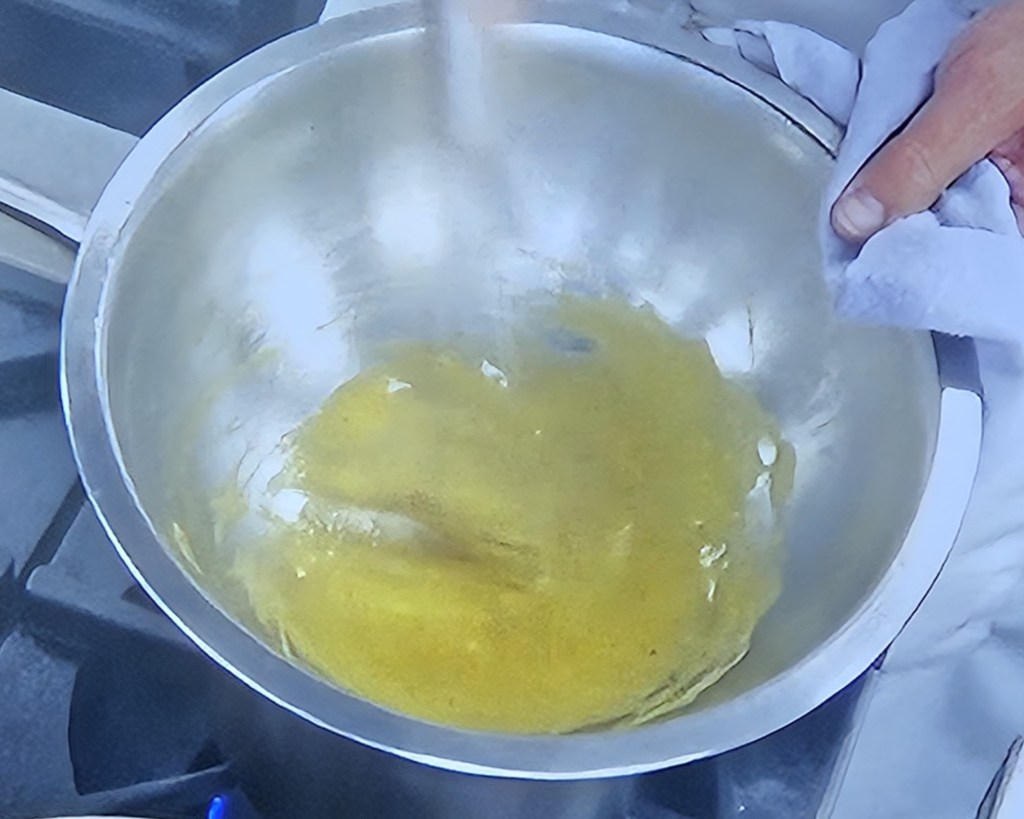
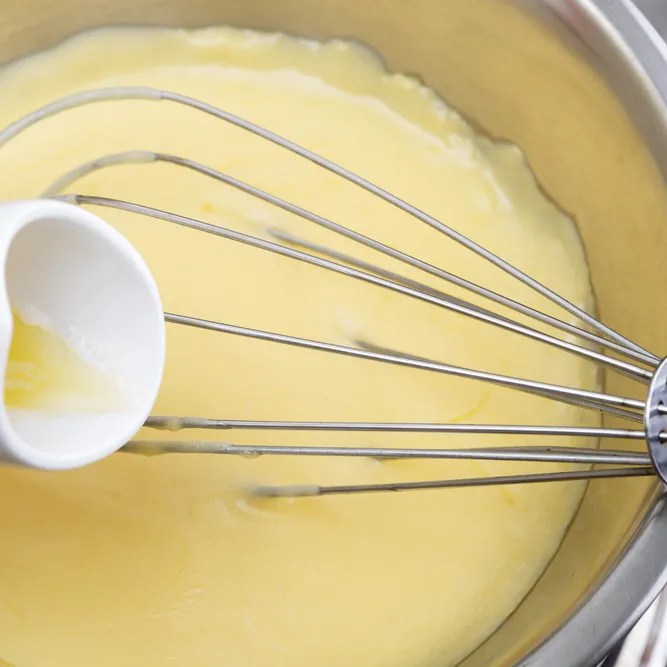
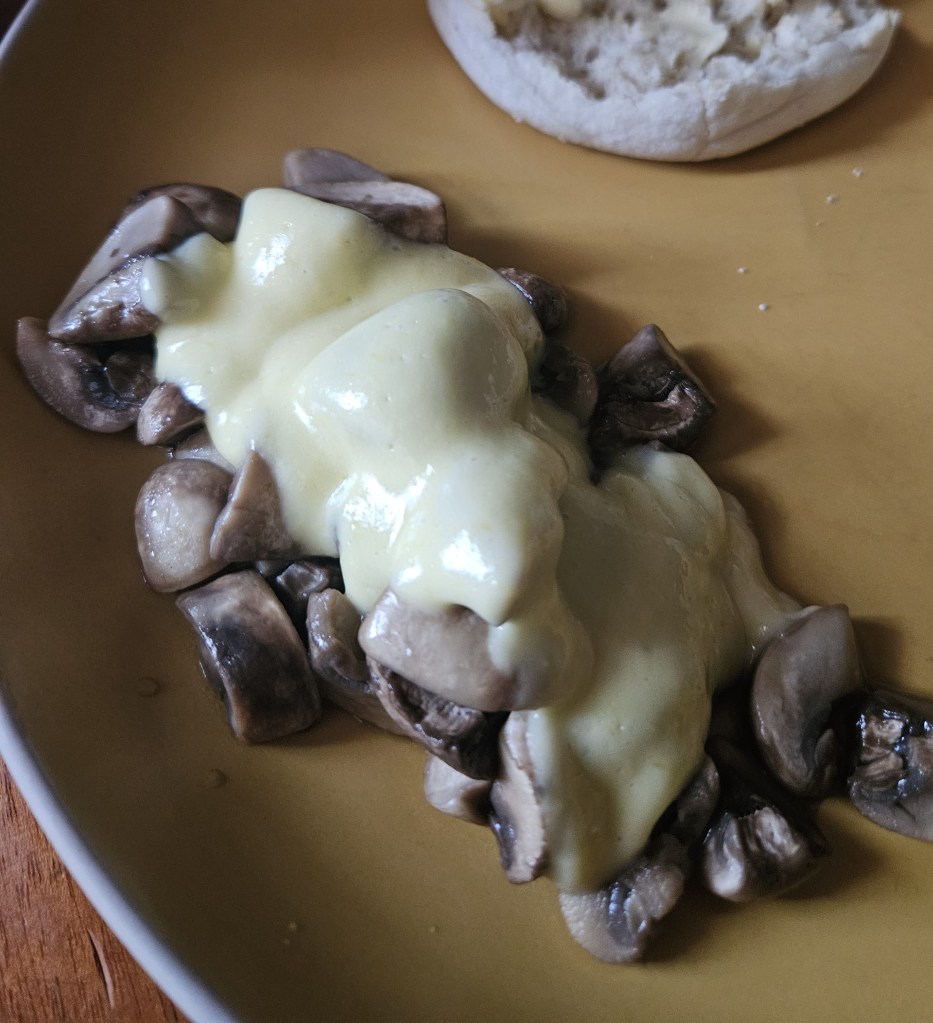
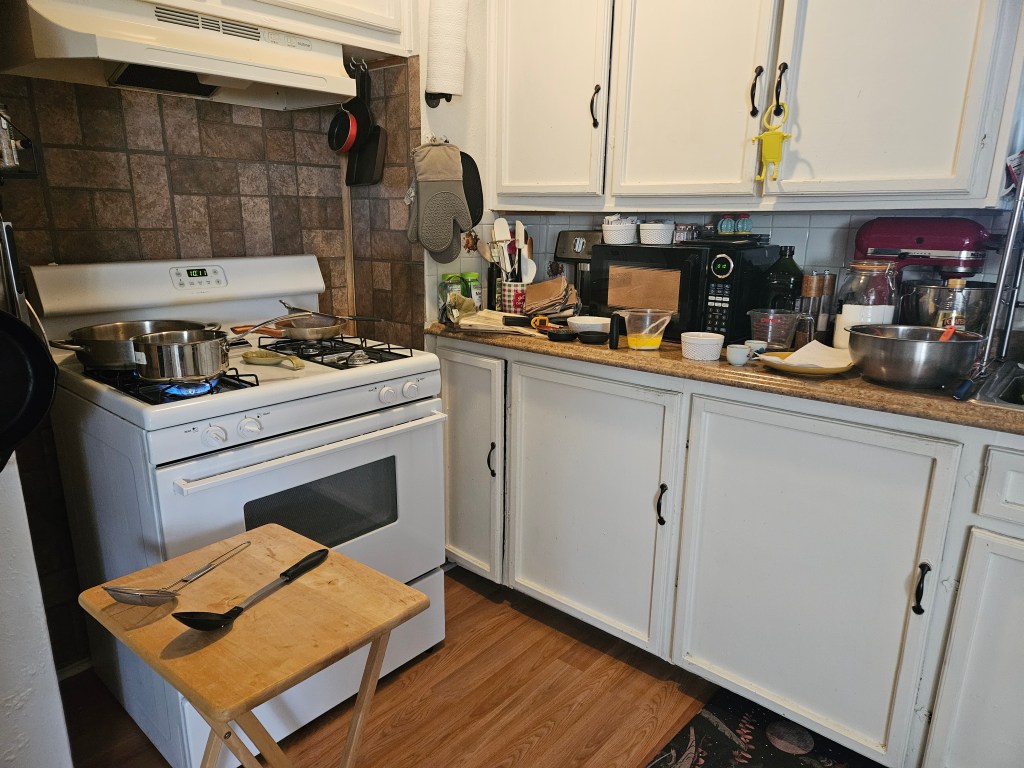
Absolutely profoundly incorrect Hollandaise.What Hollandaise should look like. (Source: Epicurious, link)Hollandaise take three, prepared at home, with sauteed mushrooms.My home kitchen, exploded. All this for two servings of Hollandaise and two poached eggs.
The best part is when you taste the Hollandaise that you bled, sweat, and cried over and you realize…you don’t even like it.
“If you think you’re done, you’re only halfway there.” – Chef
The quote above was technically about chopping parsley, but I’m learning not to underestimate the universally applicable wisdom of simple cooking instructions. I tend to rush while cooking (an in life), a bad habit at home exacerbated by the stress of the kitchen lab. I always feel like the slowest, the last, that everyone else has landed on some sort of fast track to success. While its true that good things take time, its also true that things take time. So much of the technique I study in class is about when to move and when to wait. It makes a huge difference in the quality of food. Monitoring your time is also critical for staggering dishes in order to plate properly. This obstacle is one of the next to tackle in class. It’s been hard enough to plate two hot eggs onto a hot plate, but I’ll soon be asked to prepare full dishes like Eggs Benedict, with each item perfectly hot and delicious.
The foundation for creating a full and complete dish is sauce-making. Chef declared the next two weeks as critical not just for class but for our careers as potential chefs. Sauces are what separates a home cook from a chef. For many of us that cook at home, sauces are an afterthought. Maybe we do a quick deglaze after roasting meats and serve that with our entree. More often, sauces barely make an appearance in modern amateur recipes, only popping up after everything is complete, phrased in some vague way like: “Serve with pesto.” or “Drizzle with your favorite hot sauce!” For a chef, sauces are an integral part of the dish, as important as any other element, and are designed to complement and elevate eating. Texture, scent, viscosity, as well as taste, mean that a sauce is often that secret alchemical ingredient that elevates a plate from delicious to memorable.
Day One required the Mother Sauces: Bechamel, Velouté, Espagnole, and Tomato. We also did Mayonnaise, which isn’t technically one of the Mother Sauces, but Hollandaise was coming on Day Two and we needed to learn how to create emulsions by hand. These traditional sauces act as building blocks. Once you master them, you unlock a plethora of “Small Sauces,” and your sauce-making retinue grows exponentially. Essentially, liquid + thickening agent + seasoning = Mother Sauce. Mother Sauce + other whatnot = Small Sauce. Each Mother Sauce can be the foundation for dozens of other sauces. Basically, you just keep building and building until you get the flavor you want. It’s brilliant in how simple it is, each sauce branching out like the taxonomy of animals. From a primordial white roux comes an elegant Bechamel, then a cheesy Mornay…
First up, is the Bechamel. A white roux (lightly cooked flour and fat) with more milk, grated nutmeg, and an absolutely ridiculous-looking item called an onion pique (a bay leaf skewered on an onion with a few whole cloves). I was unconvinced of its culinary heft, but simmering it in the sauce infused a sort of “essence” of onion and spice. I usually don’t care for dairy-based sauces, but this one ended up being fragrant, flavorful, and somehow quite light despite being a rich sauce.
Bechamel with simmering onion pique.
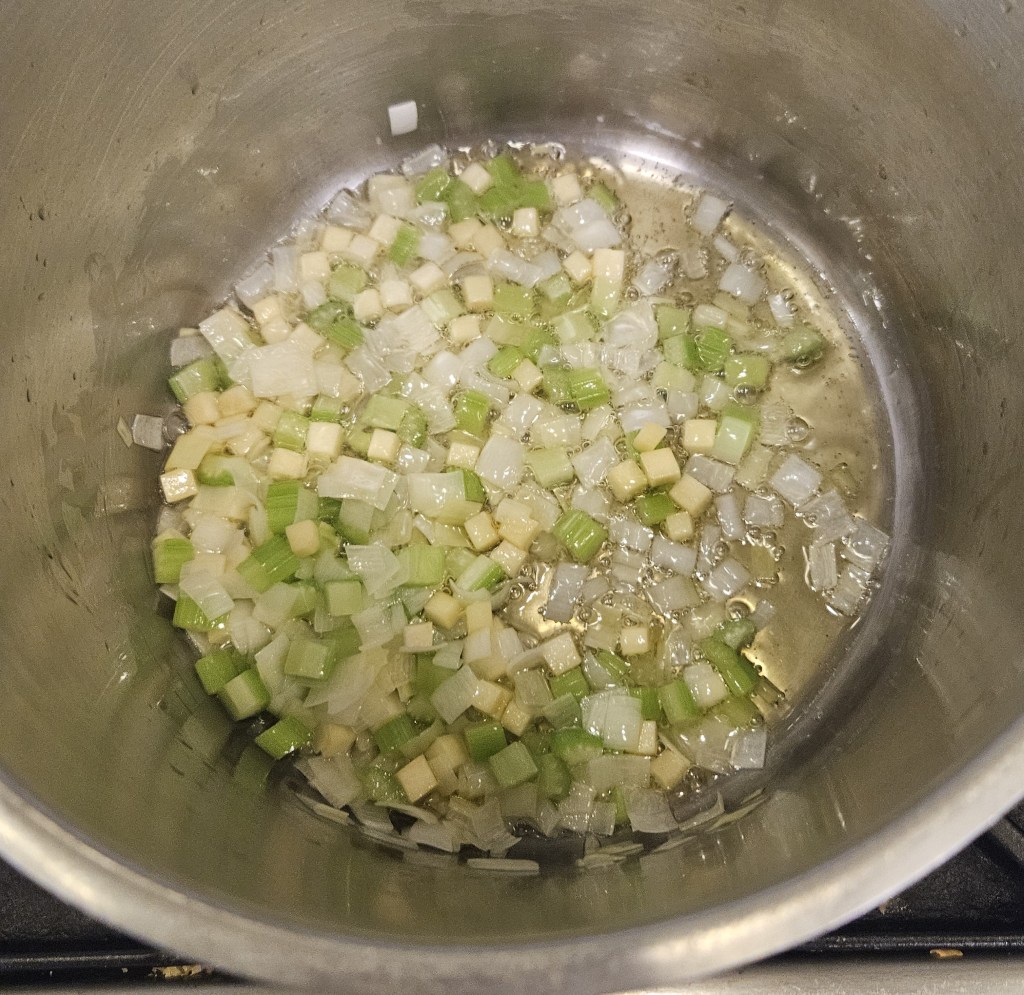
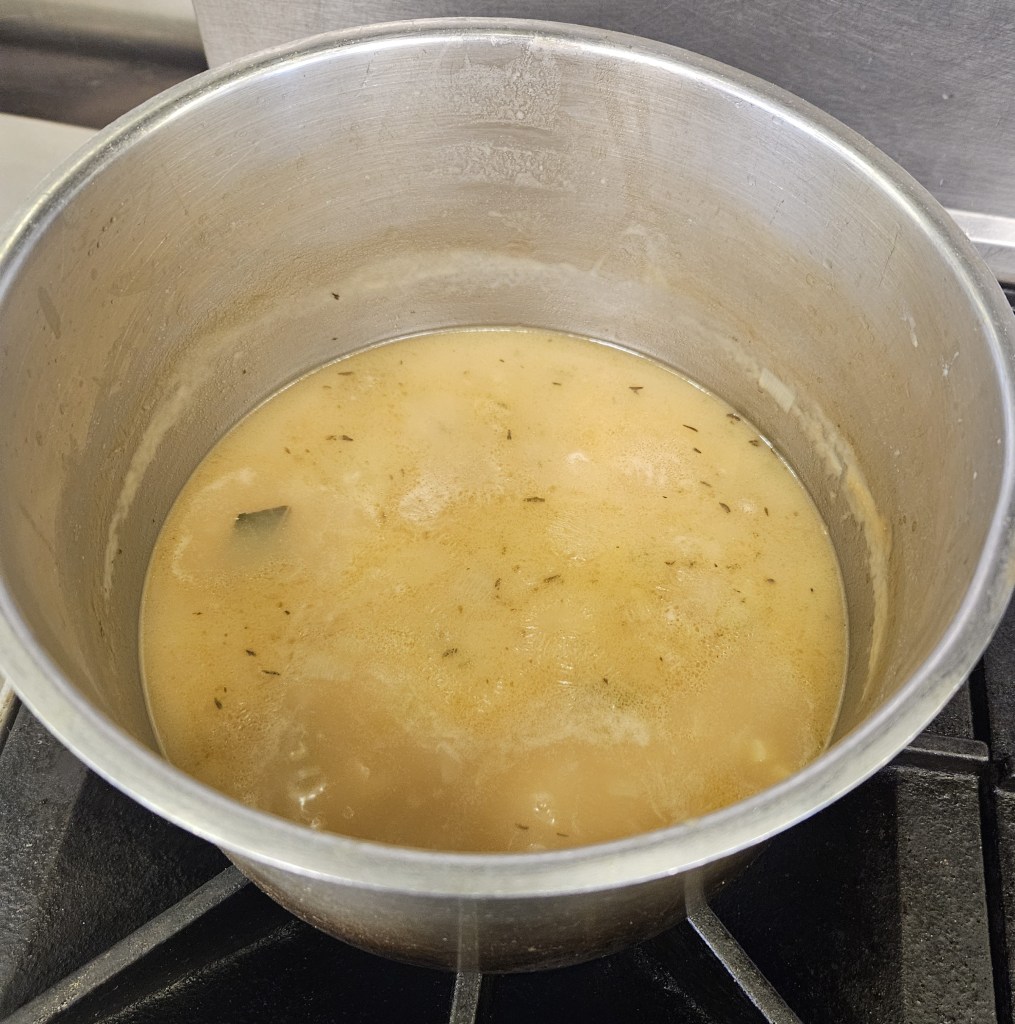
Next, we did a Velouté. A lighter mirepoix base (parsnips for carrots and leeks for celery) imparted similar flavors as a regular mirepoix, but kept the color of the sauce paler. Simmered with more herbs and stock, the flavor is like the greatest chicken noodle soup you’ve ever had.
A white mirepoix: leeks instead of onions, parsnips instead of carrots, and celery. Velouté, about halfway done.
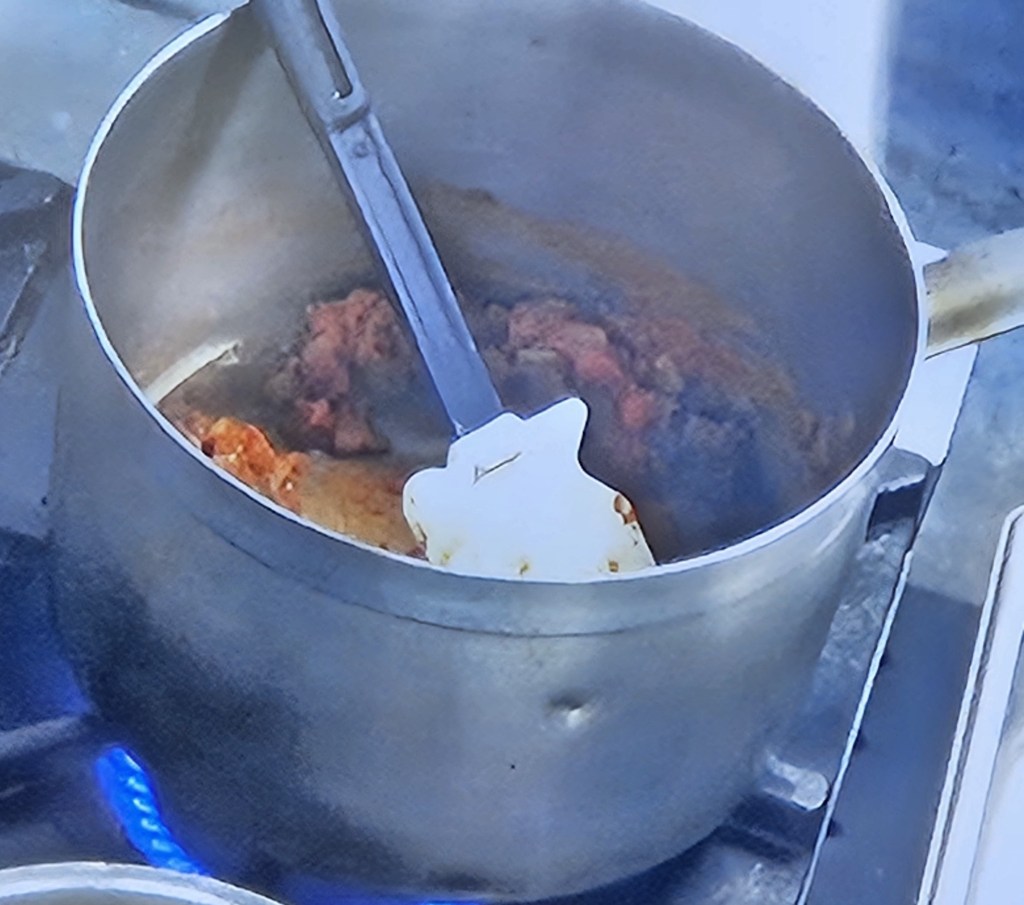
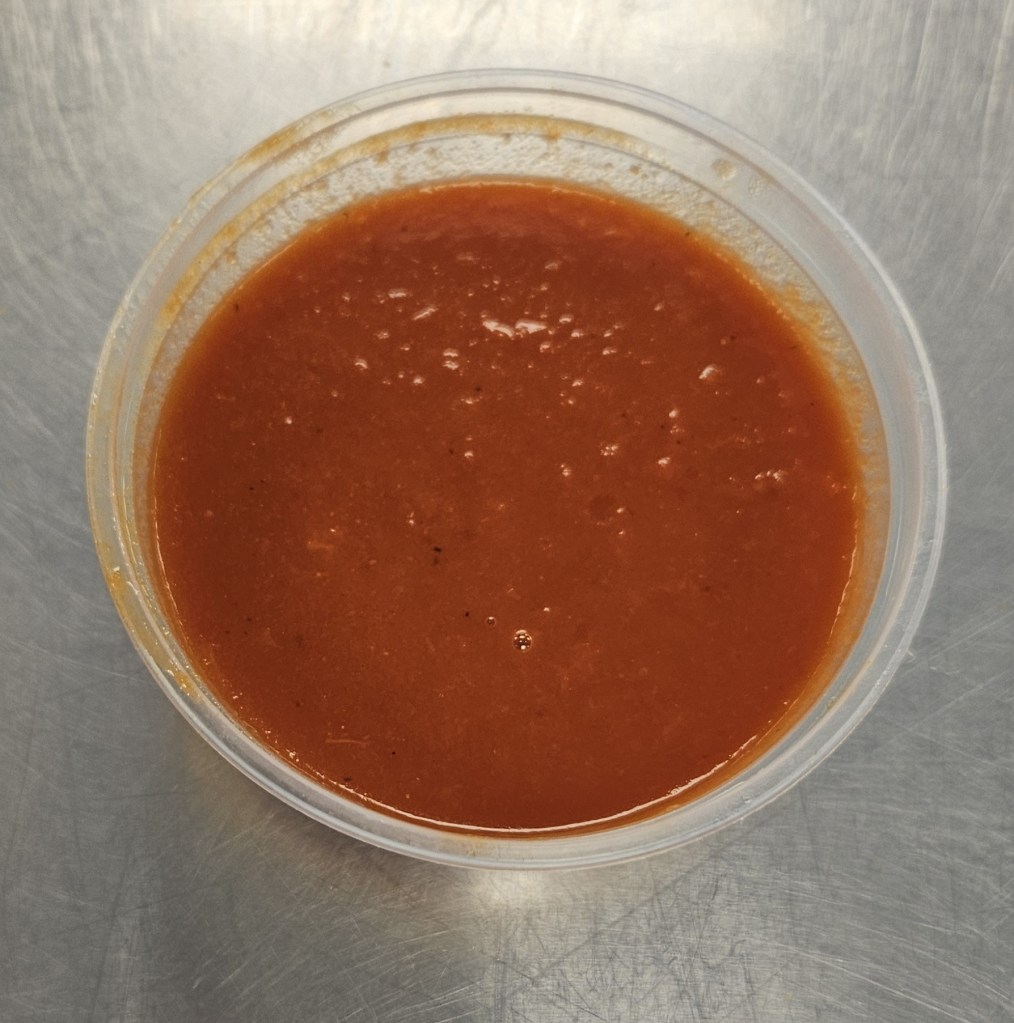
Espagnole uses a darker brown roux, more vegetables, and adds some tomato for a rich beefy taste. The roux and vegetables are cooked together to reach caramelization, adding a delicious sweet later tot he flavor of the sauce. Tomato is a simple tomato base with light herbs, like (but not identical to) a restrained marinara. As someone who likes the bold taste of a “red sauce” (shout out to Long Island Italians), I was surprised at the nuance of flavor in a seemingly mild liquid.
Chef’s Espagnole vegetables and roux cooking down.We had both been skeptical of its flavor, but my tablemate loved their Tomato Sauce so much, they brought a little home.
The kitchen lab is starting to get tight at this point. Our stoves have six burners a piece, and students compete for space. We have always been responsible for washing our own dishes, but sauce week has driven home how important tidiness and cleaning are. Chef demands we “work clean” and plan ahead. Juggling these tasks is a very real part of our education. No coworker in a restaurant is going to give up their space because you fell short.
The pressure is also mounting with items like these sauces, as we actually save most of them for future use. Messing up a sauce today means shorting yourself later. And rushing a sauce means a lackluster base for future work. Part of the reason we were able to achieve such rich flavors with humble ingredients is simply time on the stove. There’s no secret magical ingredient that suddenly imparts the complexity brought by mere heat and time. More life lessons that I seem to need to hear over and over again…
“Being a chef, cooking, conditions you to the tiny technical satisfactions of properly executing a single plate. Having kind of a private moment with that plate sits there momentarily in the window before it goes out to the dining room to be ruined, where you look at it and you know you did this particular thing well. Learning to like something so temporary, so fleeting…I think that’s been useful in being happy” – Anthony Bourdain
The midterm is week-long process in which half the class cooks and the other half cleans. The ones cooking have 2.5 hours to prepare a super long list of items. I’m still nursing a few wounds, and I don’t know if I can post the details here. But, what I will say is that all the students passed, I got an “A,” and we learned a lot. In lieu of formal class post, here is a list of things I’ve learned or have been strongly reinforced in culinary school so far :
You need to season at all points in the cooking process, not just the end. A lot of people think this technique will make food too salty. The actual truth is that food absorbs and transforms salt if you add it as you cook. It becomes layers of tastiness. The salt bomb added only at the end of cooking is what typically makes foods taste “salty.”
Refrigerators are for holding cold food, not for cooling food.
Mayonnaise at the picnic didn’t make you sick. It was the sliced tomatoes or the unwashed lettuce.
The odd-looking tall or floppy chef’s hat are for purpose. First, they help with ventilation in a hot kitchen. Second, they keep us humans from contaminating food as we may accidentally touch our hair or wipe our forehead. This item doesn’t prevent it all, of course, but it helps with a lot of the unconscious touching when we get overheated.
If you are wondering what the magical secret ingredient is, it’s butter. Just a shit ton of butter.
If you don’t know which knife to use, a good general rule is make sure your knife is longer than the thing you’re trying to cut.
For the love of everything, let your meat rest. (About 8 minutes per pound)
For the love of everything, sharpen your knives.
If you can learn to butcher a chicken, it is the most cost-effective and delicious way to go. Use the carcass and scraps for the most delicious stock ever.
The more finely chopped a piece of garlic, the stronger the garlic flavor (so slices are less potent than mince).
Your home kitchens are more than likely way dirtier than restaurant kitchens.
Break eggs on a flat surface by tapping lightly, not the curve of a bowl. You risk breaking more shards of the shell on a curve.
Taste your food. Toss a few spoons near you when you’re cooking. The only way to learn if you are an over-seasoner or an under-seasoner (plus a million other things) is to just taste as you go!
The people that prepare your food, that stock your food, and that come up with the recipes that you use, work so much harder than you will ever know. I’ve never been more physically, emotionally, and intellectually stretched as I have in culinary school. Treat them well, tip them well, and enjoy the fruits of their labor!
“Every second counts.” – The Bear, S2 Episode: “Forks”
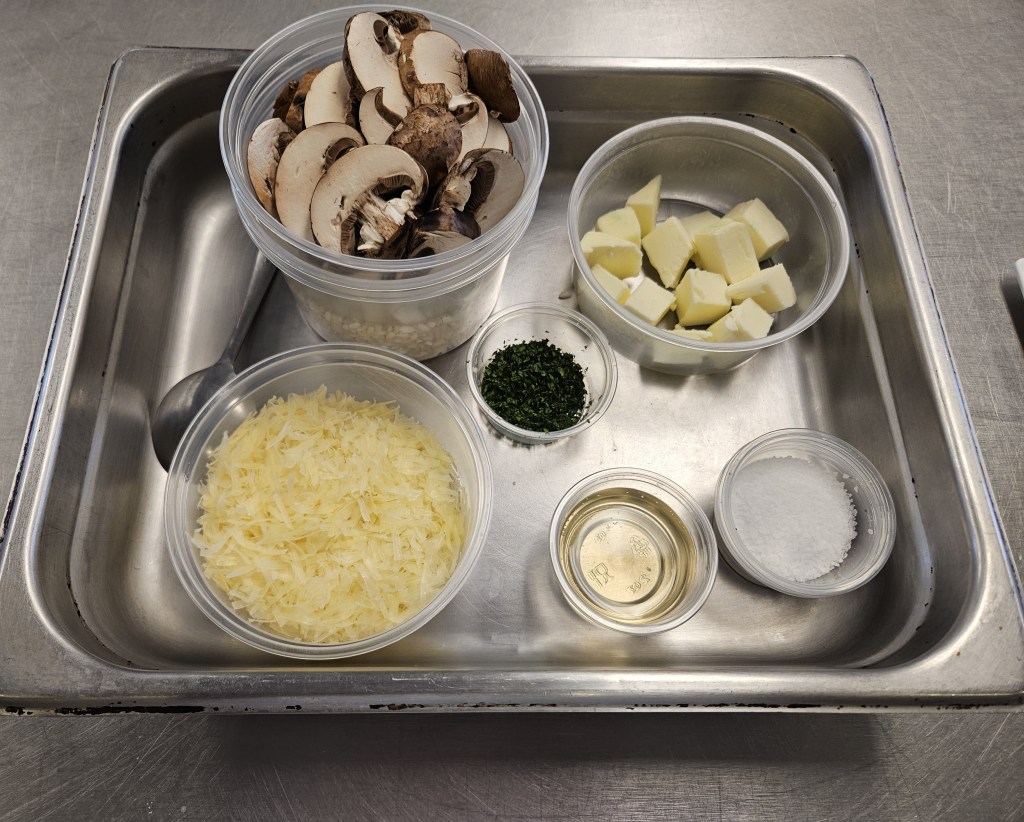
Today’s class marked a critical shift in our lab work. Up until this point, we’ve been doing one-off techniques and dishes, with the most complicated recipe being a bruschetta. Today moved us into actual recipes using starches: Steamed Rice, Rice Pilaf, Whipped Potatoes, and Risotto.
I was excited about it all, but absolutely overjoyed at risotto. Dishes like risotto – technical, historical, impossible to find accurately prepared at a restaurant – was one of the reasons I signed up for culinary school. You can find dozens of online recipes, Youtube videos, opinions from celebrity chefs, detailing risotto and its proper technique. Culinary school introduced me to an instructor with decades of experience who learned risotto in Italy, and refused to compromise on any other definition or interpretation. We were learning real risotto. Period.
I spend a lot of time preparing for class, relishing the intellectual challenge of planning for ideal timing, perfect preparation, and the pathway to flavorful but simple dishes. I calculated the conversion rates (we scale back whole recipes for our individual practice) and wrote myself notes on techniques shown in the instructional videos. I befriended a lovely fellow student who strategized with me the day before. We both agreed rice, like eggs, were deceptively easy. People underestimated those tiny grains. They need attention, wisdom, confidence, and luck.
Being a student is one of the most difficult roles anyone can embody. It doesn’t matter what type of student. No one learning has it easy. If you’re struggling as a student, you feel disconnected and lost, watching everyone else’s back as they leave you behind. If you’re succeeding, confidence can start to get heavy, and the pressure to continue to succeed weighs around your neck as you try to keep your head up.
Before lab that day, Chef made a point to show the class my planning work, explaining how well I prepared and how the other students needed to step up their prep game. My heart sunk. The compliment from Chef faded away amid the white noise of memory. Being singled out for doing poorly feels horrible. Being singled out for doing well feels, in many ways, just as bad. My identity in class changed that day.
I’ve shared before how the class doesn’t really compete among themselves. No one throws elbows to get Chef’s attention. But we’re also all here because we want to be. The desire to do well, and get through the challenging physical hours of class, are intense. If one person was singled out for doing well, wouldn’t you ask them for help?
My meticulous preparation evaporated. Fellow students came up to me with questions, asking to see my work, wondering how I approached the conversions. None of their questions were rude or inappropriate. And I am good at setting boundaries. Repeatedly, I redirected questions to Chef. But, as someone with sensory issues, the interjection of my name quickly became grating. My concentration was broken again and again. I struggled to stay focused on the tasks at hand. More than that, my diligent preparation was still very much that of a student. It didn’t automatically translate into me actually knowing what I was doing. Most of the time, I had to respond to well-meaning inquiries with “I have no idea.”
I knew going into this class that the most important dish for me to present to Chef was the risotto. I had practiced and studied, with no illusions that I would do well. I just wanted feedback. He had suggested to the class to start other dishes first and then get to the risotto. I blatantly ignored him, knowing it was likely a mistake. But the shift in class communication had me flustered, and, in my distraction, I let my mise en place slip. I wasn’t prepared for the dishes in the proper way and I saw quickly that my time was running out (again). This setback was different from tanking eggs over and over. This class was about rice and I was going to show nothing except risotto. I managed to prepare my mirepoix for rice pilaf. I threw hastily chopped potatoes into water. But the clock wasn’t lying. I was only going to be able to show risotto, so I just focused solely on that.
Some mirepoix for an imaginary rice pilaf.
I ladled each portion of broth carefully, the grains not leaving my sight. I stirred and pushed and seasoned and tasted. I watched my potatoes sit in water waiting to boil. I saw my chopped vegetables sitting sadly in a bowl at my station. Somehow 45 minutes of risotto eclipsed the two and half hours I had to prepare. Overall, I fumbled. I couldn’t blame this one on a fancy flip. I had let the outside world in and lost my grip on the cook.
Pre-RisottoStiffened up, but still delicious.
The one thing that kept my from tears was the review of my risotto. I had botched the plating, taking about 60 seconds longer than I had available. In that time, the delicate dish stiffened up. It was solid ont he plate, instead of beautifully lava-like. However, Chef declared the flavor immaculate, and said it was better than 90% of the risottos he had tasted in the state (though mine was quite stiff, like theirs). He even said that, as he watched me err in my plating, he saw that the product coming out of the pan looked great. “If you had plated it properly, it would have been great. Right now, it’s just good.”
“Some goals just ain’t meant to be microwaved, baby.” – LaNia (tiktok)
This week was the one that changed the kitchen lab for me. I’m still not sure if for better or worse…
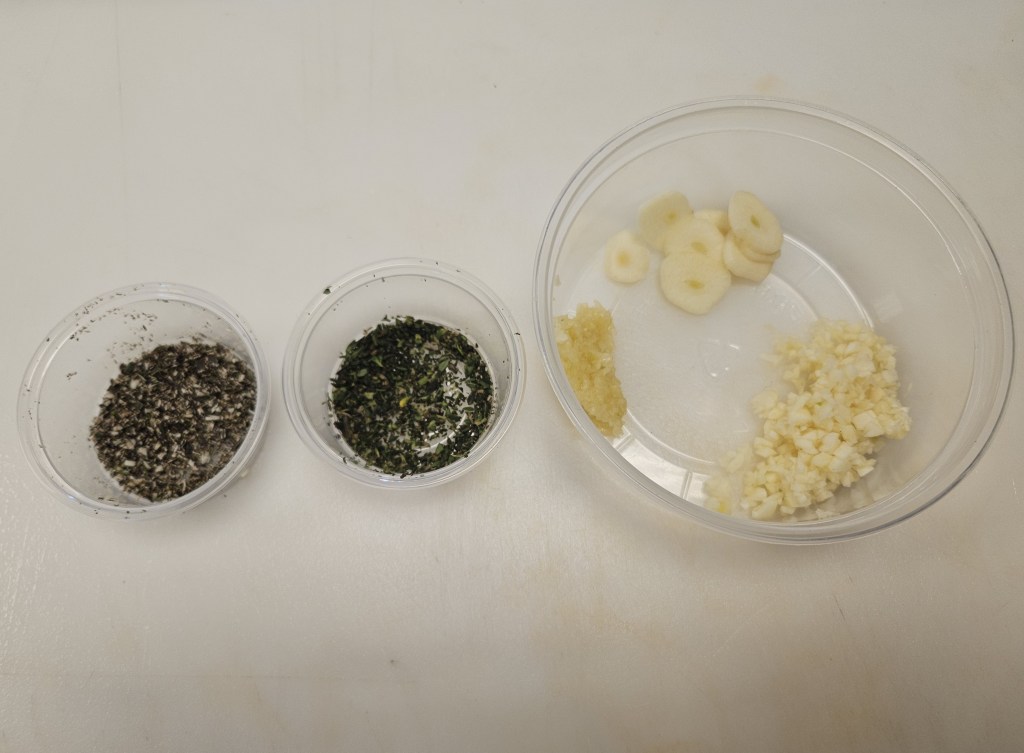
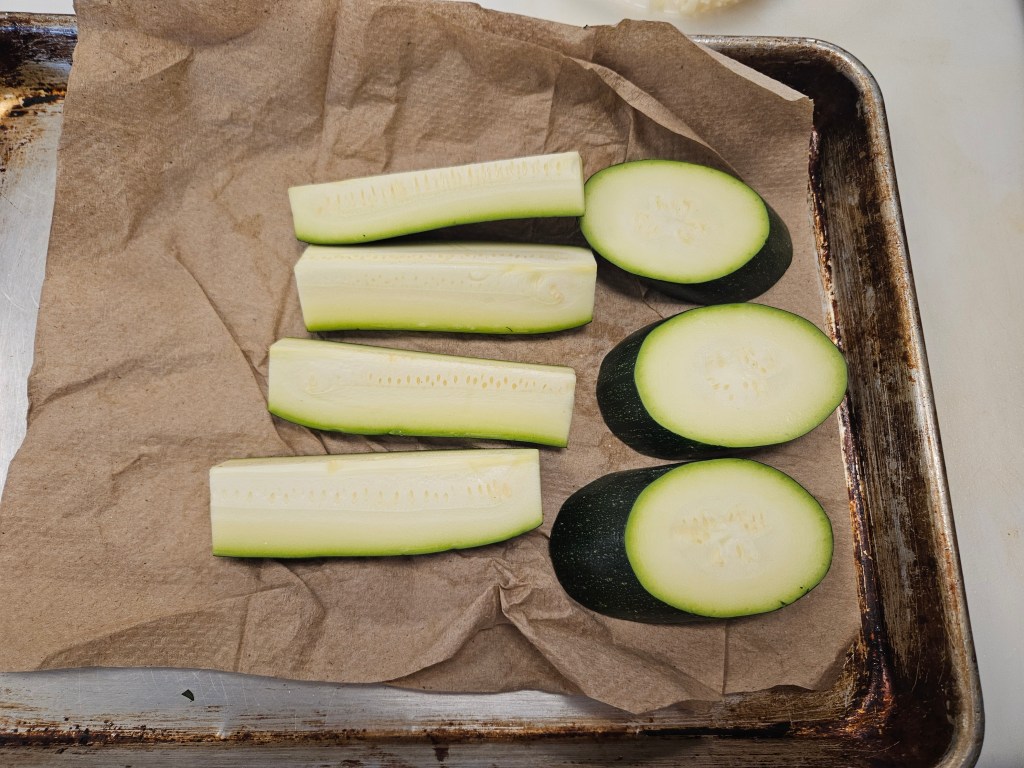
Next week is the midterm exam, so this week’s work was all about more practice and preparation. We would fabricate another chicken, saute a breast, pan fry a leg and thigh, and practice more knife skills. Those included sliced, chopped, and mincing garlic into a paste, chopping various herbs, and slicing and grilling zucchini. We also learned multiple methods for slicing vegetables like bell peppers and onions for different preparations.
I’ve started loving the thrill of multiple tasks, and getting to approach them in my own ways. I feel more in control of my work, making the wins that much more meaningful.
Chopped herb practice, and garlic three ways. I’ll never go back to buying garlic paste again.
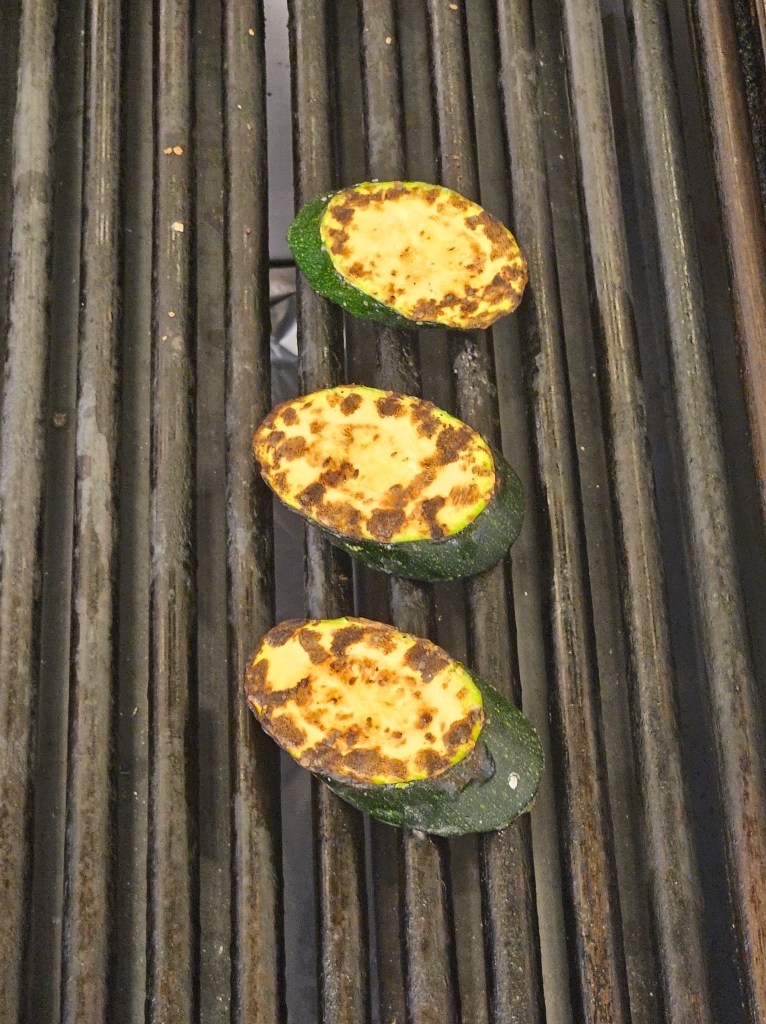
Slicing vegetables and preparing garlic and herbs is very much something I love doing at home, so I knocked those out quickly. Preparing and grilling the zucchini was sort of a thankless task. At the end of slicing and cooking, you still just have…a brownish zucchini. Chef did say my seasoning was on point, though, and that I was successful in making zucchini look edible (for the win?) with “great color.” I’ll take it!
The secret to water-heavy vegetables like zucchini standing up to the grill are thick, even cuts. Shrinkage is real, people.You can’t really get the cross-hatch marks on zucchini (correction: I cannot), but you can still get a nice color with proper seasoning and patience.
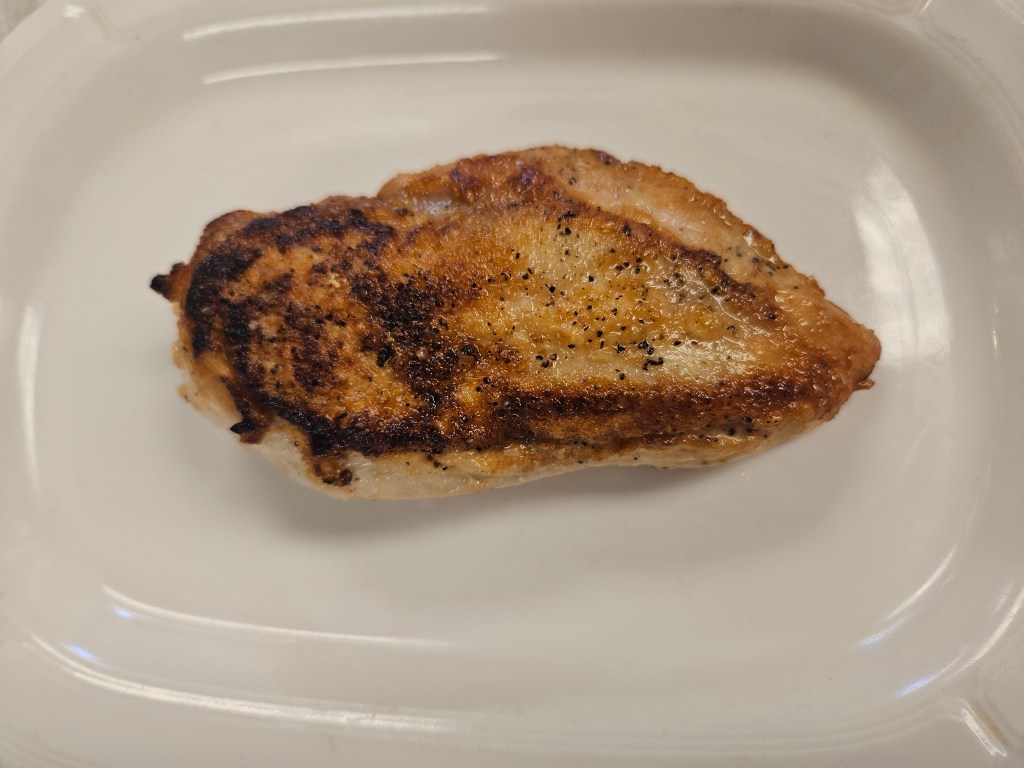
I am getting disturbingly fast at breaking down a chicken, as well as pan frying. Sauteeing still keeps throwing me off. Today, time was once again not on my side. Chef began counting down minutes while I was convinced my breast was still underdone. We had to saute with skin on today, making timing even more difficult. How to keep things crispy on the outside, juicy on the inside, and still fully cooked…
I pulled the breast for a blink-and-you’ll-miss-it rest, as minutes turned to seconds. I had to plate quickly and was sure I was presenting an underdone piece of meat. It turns out that time constraints actually forced me to cook the breast properly. She was perfect, and Chef even laughed at me a little, since I was forced to get out of my head and JUST COOK.
The sexiest of sautes.
Things were starting to feel good. Really good. I was getting a handle on my real skill sets in the kitchen, and seeing where I needed practice. Having a growth mindset is tough, but it’s about getting back up. Today’s class was one of the first times I felt the home cook meet the kitchen lab cook, and visions of a possible future chef seemed less like a strange dream and more like a future. I still wasn’t sure where I wanted to end up. The kitchen life is hard, and I am a creature of comfort. I don’t like sweating, or yelling, or burning myself, or standing up for hours. And yet, something happens to me when I’m in class. Some sort of core activates inside and I just move. I am in no way great. And in no way even good. But there is something electric inside me when I chop, and cook, and plate, and move on to the next task. I still don’t know quite what it is or what it means, but it’s becoming harder to ignore.
Ironically, the next class brought total catastrophe and pushed these feelings even deeper into my mind. On a day where everything goes wrong, and everything around me is miserable, on a day where I epically and publicly fail spectacularly, do I still love to cook? Could my worst day in the kitchen also be my best day?
















 Tiger Tail Kitchen